Many organizations still rely on software built ten, twenty or even thirty years ago. These systems often support mission-critical operations, yet they become harder to maintain, integrate and evolve. The challenge is modernizing them without interrupting day-to-day business. Today, proven modernization strategies allow companies to upgrade their technology step by step while maintaining operational continuity.
What is a legacy system?
A legacy system is a business-critical application that has been running for years, often built with outdated technologies or architectures. It may manage finance, logistics, manufacturing, inventory, HR or other essential processes.
Being legacy does not necessarily mean being ineffective. Many organizations continue to depend on these platforms successfully. The real issue arises when maintenance costs increase, integrations become difficult and innovation slows down.
Why modernize?
Modernization is usually driven by business needs rather than technology alone. Organizations seek better scalability, lower maintenance costs, improved security, cloud adoption, easier integrations and faster delivery of new capabilities.
Avoid the 'big bang' replacement
Replacing an entire enterprise system at once is often expensive, risky and time-consuming. Large replacement projects frequently suffer delays, budget overruns and operational risks.
A phased modernization approach typically delivers better business outcomes.
The incremental modernization strategy
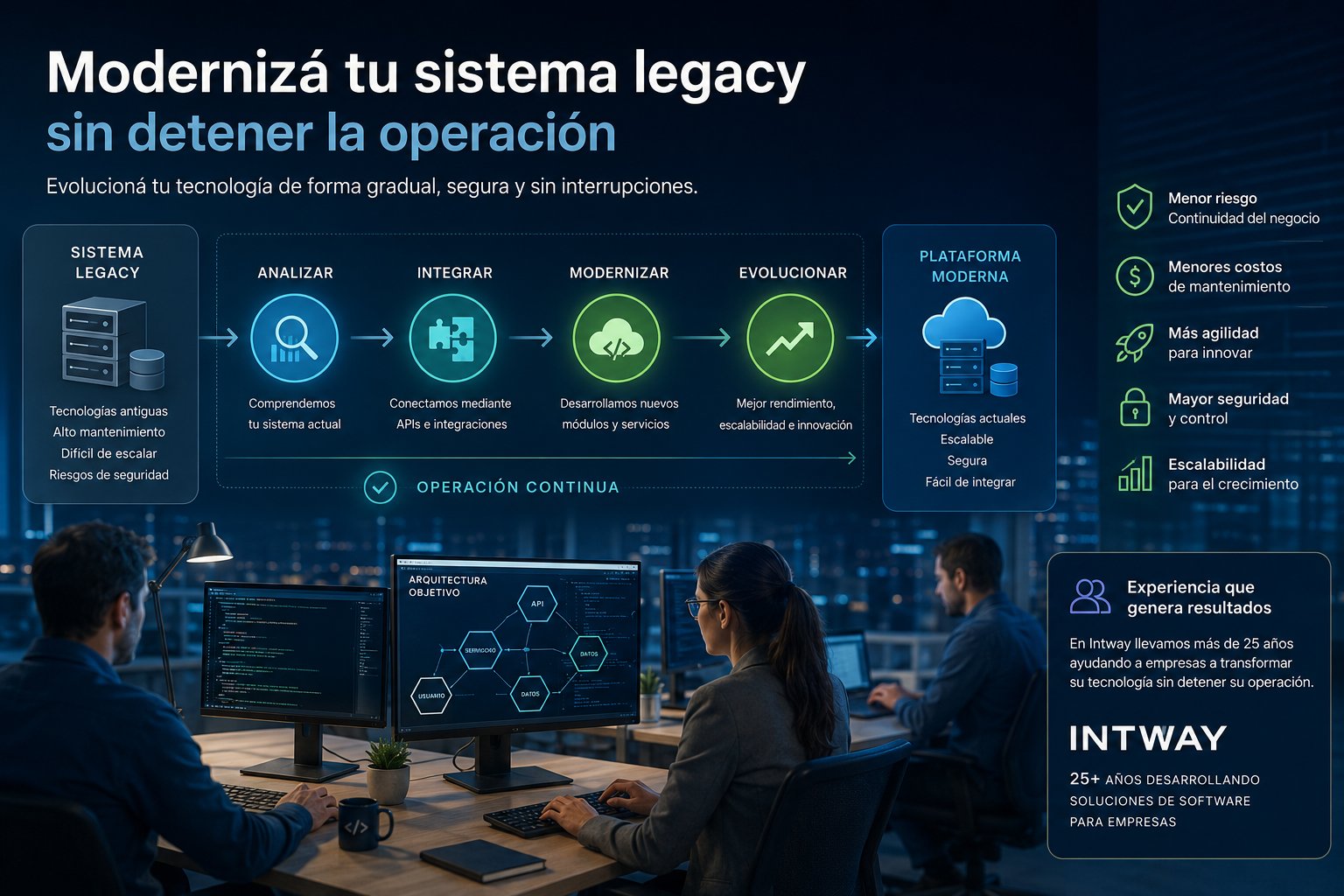
Incremental modernization replaces or upgrades one component at a time. Existing functionality remains operational while new modules are gradually introduced.
Assess the current platform
Understand dependencies, business processes and technical constraints before defining the roadmap.
Prioritize high-value modules
Focus first on components that generate the highest business impact or maintenance effort.
Expose existing capabilities through APIs
APIs enable modern applications to interact with legacy platforms while reducing direct dependencies.
Develop modern services
New capabilities can be implemented using contemporary architectures and integrated progressively.
Retire legacy components
Once new modules are stable, older components can be safely decommissioned.
Business benefits
- Lower operational risk.
- Business continuity.
- Reduced upfront investment.
- Faster delivery of business value.
- Improved scalability.
- Enhanced security.
- Better user experience.
Choosing the right architecture
Modernization often combines APIs, microservices, cloud platforms and event-driven integrations. The optimal architecture depends on business goals, transaction volume and technical constraints.
Common mistakes
- Ignoring business stakeholders.
- Underestimating system complexity.
- Modernizing everything at once.
- Skipping automated testing.
- Failing to define measurable outcomes.
Working with an experienced software partner
Successful modernization requires expertise in both legacy technologies and modern software engineering. An experienced software development partner can design a roadmap, reduce implementation risks and ensure business continuity throughout the transformation.
With more than 25 years of experience building enterprise software, Intway helps organizations modernize legacy systems through pragmatic, low-risk strategies focused on long-term business value.
Conclusion
Modernizing a legacy system does not require shutting down business operations. A phased strategy enables organizations to evolve critical applications safely while continuing to support customers, employees and daily operations.