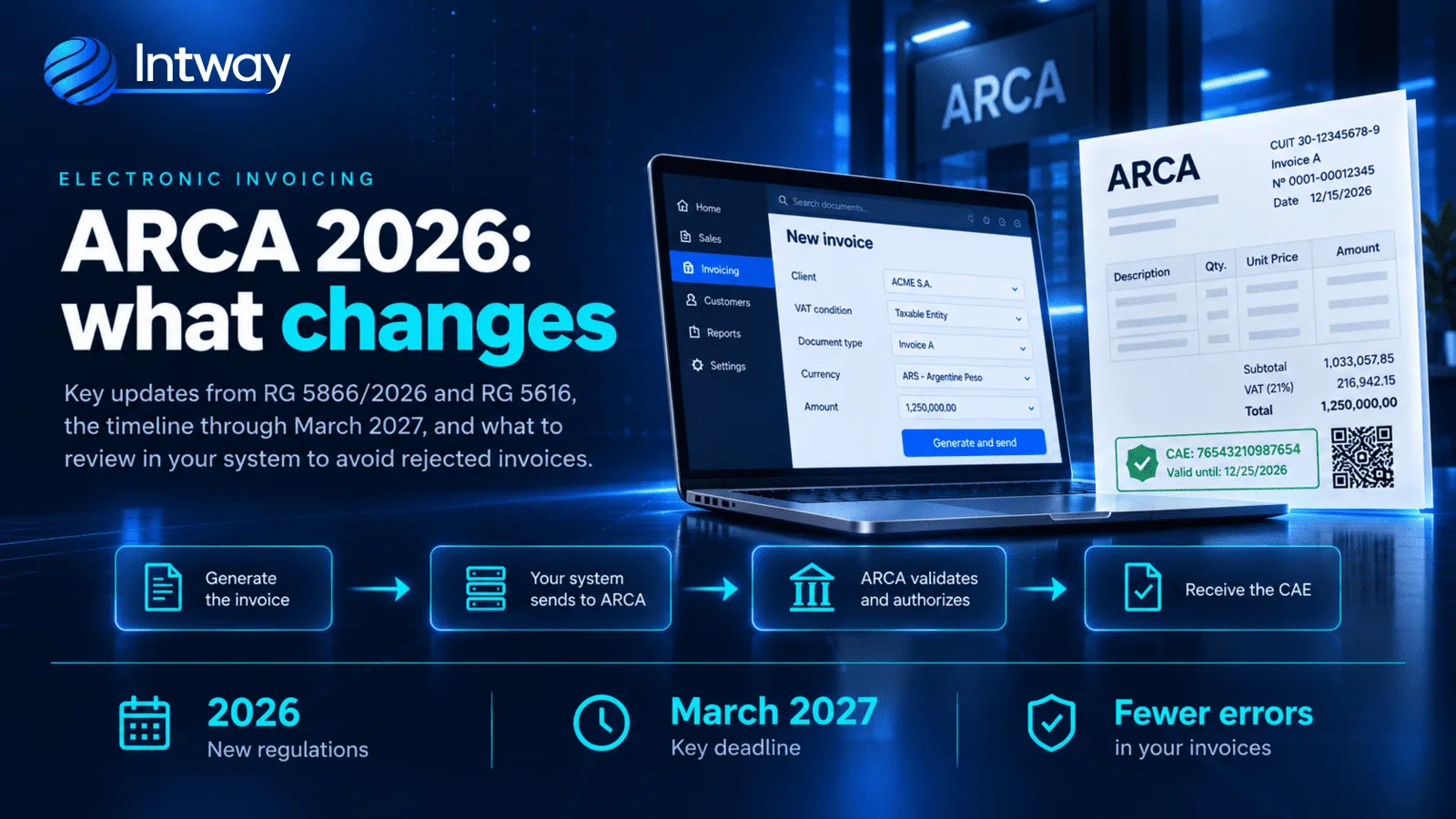
In 2026, Argentina's electronic invoicing brings two changes worth telling apart. First, General Resolution 5866/2026 from ARCA, the national tax authority formerly known as AFIP, reorganizes the e-invoicing regime and phases in new obligations through March 2027. Second, starting December 1, 2026, ARCA will begin rejecting CAE requests that do not report the buyer's VAT status, under General Resolution 5616/2024. The first rule changes specific activities and transactions; the second mainly affects companies that issue invoices from their own systems, ERPs or e-commerce platforms.
This guide summarizes what changes, when, and what to check in your invoicing system to avoid rejections.
What changes in 2026
- Buyer's VAT status: must be reported on covered invoices. Starting December 1, 2026, ARCA will not issue the CAE authorization code for requests that omit it.
- Monthly Electronic Settlement: a new option to group a single customer's transactions into one document, where the rules allow it.
- Director and statutory auditor fees: invoiced electronically since July 1, 2026.
- Newly covered industries: insurers, financial institutions, card issuers and payment system participants, in stages between September 2026 and March 2027.
- Final consumers: buyers only need to be identified on transactions of ARS 10,000,000 or more.
2026–2027 timeline: key dates
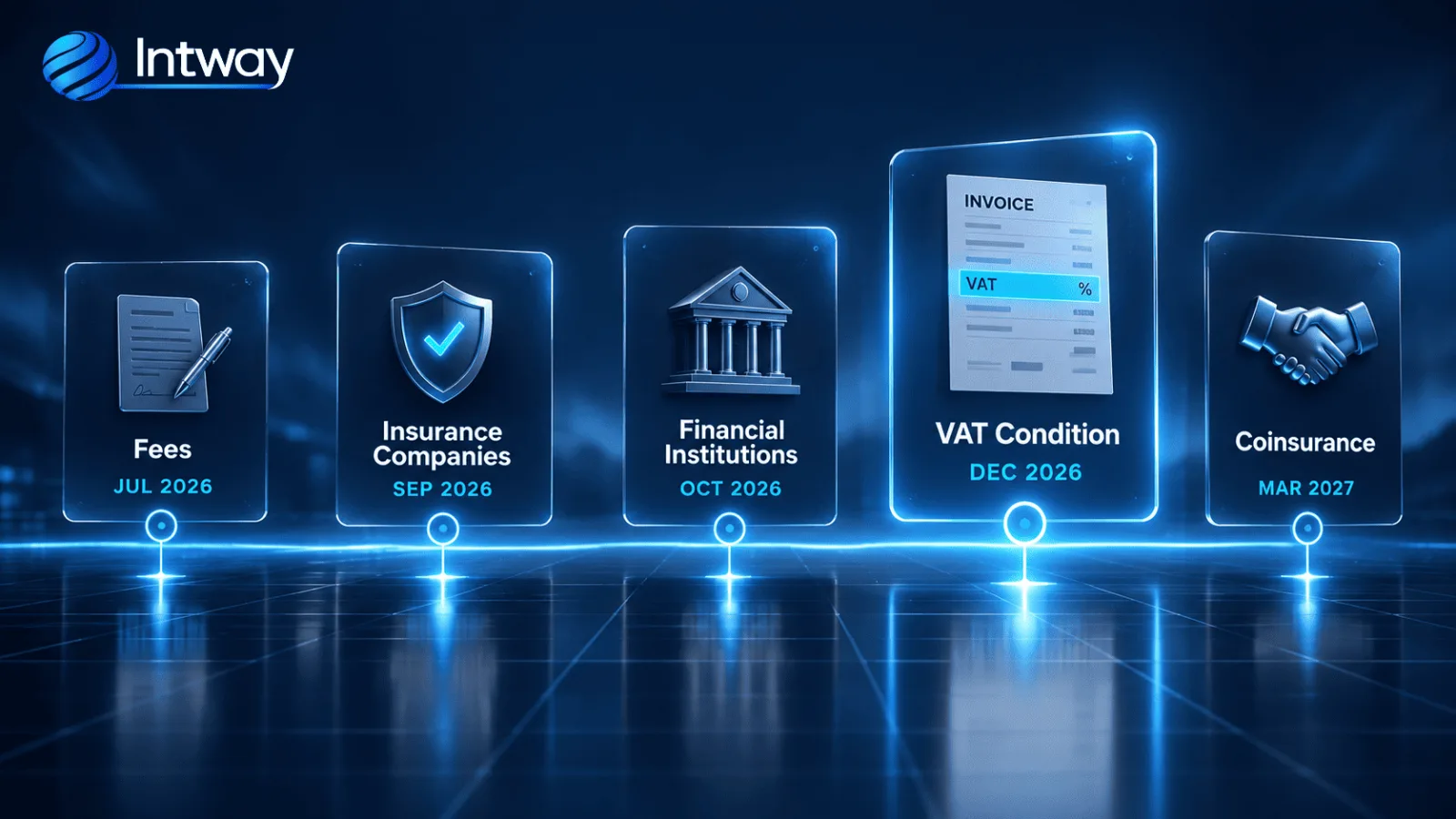
RG 5866/2026 was published in the Official Gazette on June 29, 2026 and took effect on July 1. Its obligations are phased in, and the RG 5616 date adds one more:
- July 1, 2026: directors, statutory auditors and supervisory board members invoice their fees once the individual amount is formally assigned.
- September 1, 2026: insurance companies issue invoices for transactions with final consumers and certain rebates.
- October 1, 2026: financial institutions will start issuing invoices for leasing and foreign trade.
- December 1, 2026: ARCA will begin rejecting CAE requests without the buyer's VAT status for issuers covered by the rule. Bank loans, card issuers and payment system participants will be added the same day.
- March 1, 2027: coinsurance and periodic settlements by financial institutions will be added.
The resolution also covers prepaid health plans, private educational institutions and virtual asset service providers registered with the CNV, Argentina's securities regulator.
Buyer's VAT status: obligation and validation
RG 5616/2024 made the customer's VAT status for the specific transaction (VAT-registered, monotributo simplified regime, exempt or final consumer) a mandatory field. During the adaptation period, ARCA technically allowed invoices to be authorized without it; starting December 1, 2026, incomplete requests will be rejected.
For a system that invoices through web services, this means:
- Sending the
CondicionIVAReceptorIdfield in every covered CAE request, using one of the codes returned by theFEParamGetCondicionIvaReceptormethod of WSFEv1. - Keeping each customer's VAT status current in your customer master data. Validate it against ARCA's taxpayer registry services instead of trusting data entered years ago.
- Issuing an invoice class that matches that status: ARCA validates the combination and rejects those that do not apply.
Monthly Electronic Settlement
It is an alternative to issuing one document per transaction. Where the rules allow it, a company can group a single customer's movements into one monthly settlement, issued by the last day of the calendar month and made available to the customer within the following 10 calendar days. It mainly helps companies with many small, recurring transactions with the same customer.
Final consumers: when to identify the buyer
The buyer is identified with a DNI, CUIL, CDI or, for foreigners, a passport when the transaction is ARS 10,000,000 or more, regardless of payment method. Below that amount, the data can be reported as “NR” (not required). A system that still asks for ID based on old thresholds slows down checkout for no reason.
How to adapt your invoicing system
When invoices come out of an ERP, a management system or an e-commerce platform, the connection to ARCA runs through web services, from a point of sale registered for that purpose (“RECE para aplicativo y web services” or “Factura Electrónica - Monotributo - Web Services”). The usual WSFEv1 flow is as follows:
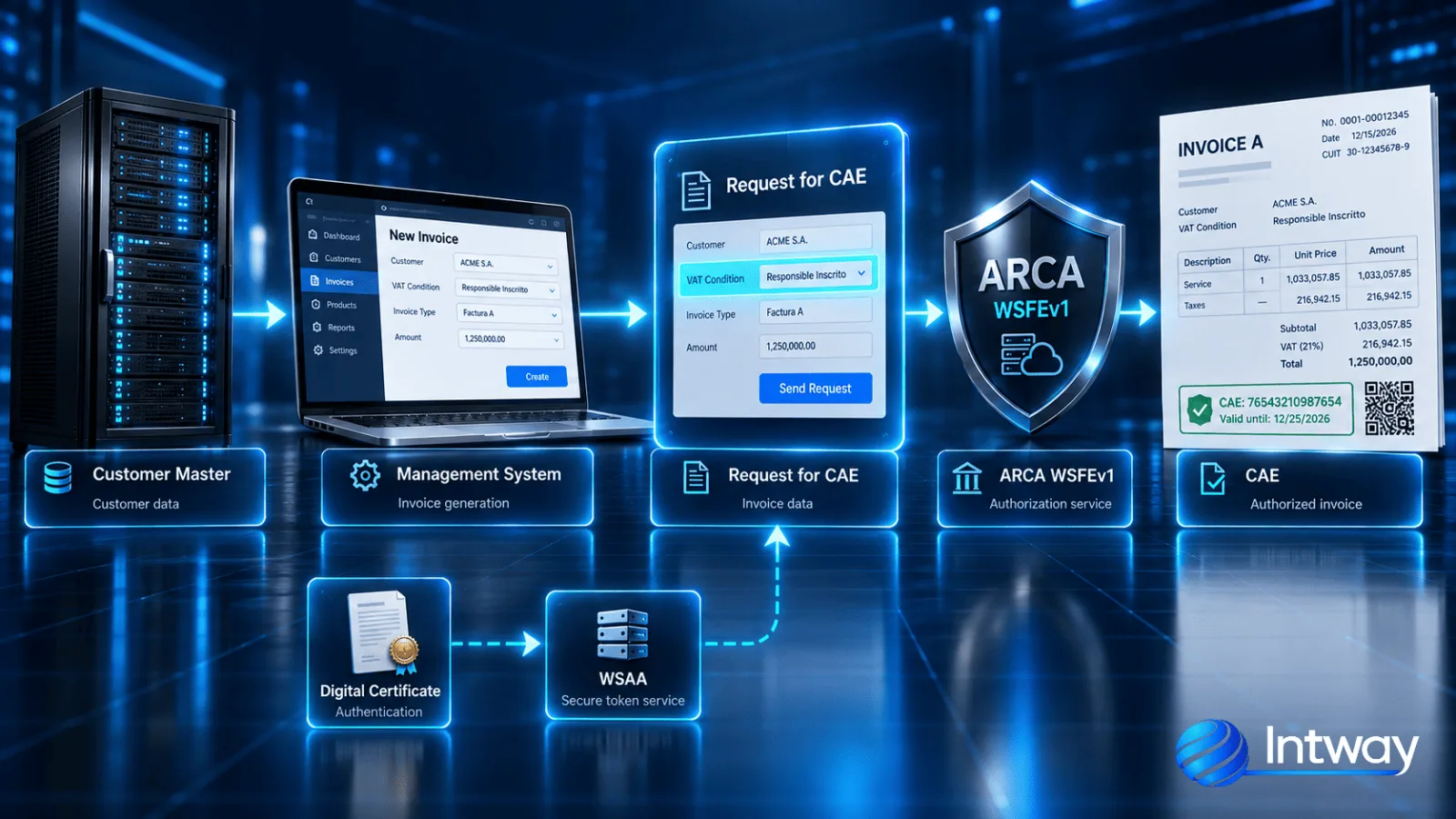
- Authentication: the system uses a digital certificate associated with the e-invoicing service to obtain an access ticket from WSAA that lasts up to 12 hours. A certificate from the testing environment (homologación) does not work in production, and vice versa.
- Customer data: it takes the buyer's VAT status from the customer master data, validated against the registry.
- Request: it checks the last authorized number for the point of sale and sends WSFEv1 the invoice, including the buyer's VAT status.
- Response: ARCA returns the CAE or the rejection reason, which the system must log and surface.
Checklist to reach December 1 without rejections
- Confirm with your system vendor that every CAE request already sends the buyer's VAT status.
- Clean up customer master data and validate each customer's status against the registry.
- Test the full issuing flow in homologación, including credit and debit notes.
- Update the final consumer identification threshold to ARS 10,000,000.
- If your company is in an industry covered by RG 5866, map which transactions must now be documented and from what date.
- Monitor the rejections and observations ARCA returns, with alerts, instead of hearing about them from a customer.
Common mistakes
- Waiting until the last week: a system change needs development, testing in homologación and a production rollout.
- Defaulting to “final consumer”: it fills the field but produces incorrectly issued invoices.
- Retrying blindly: if the connection drops after requesting the CAE, query the invoice with
FECompConsultarbefore requesting it again, so you neither duplicate nor skip numbers.
Other points to check: since April 2025, invoices to final consumers show the VAT included and other national indirect taxes (Consumer Tax Transparency Regime, Law 27,743). And since July 2021, VAT-registered companies issue class A invoices to monotributo customers, with the legends required by RG 5003.
How Intway can help
If your system will not be ready in time, there are two paths: adapt your current integration or evaluate an invoicing solution that can be adapted to the new requirements. At Intway we work on both. We integrate e-invoicing with custom ERPs and with e-commerce and marketplaces, and we offer an invoicing, CRM and ERP system with e-invoicing, inventory and multi-branch support. For banks, insurers and fintechs covered by RG 5866, we build software for financial services integrated with existing systems.
ARCA's official web service documentation, in Spanish, is on the ARCA website.