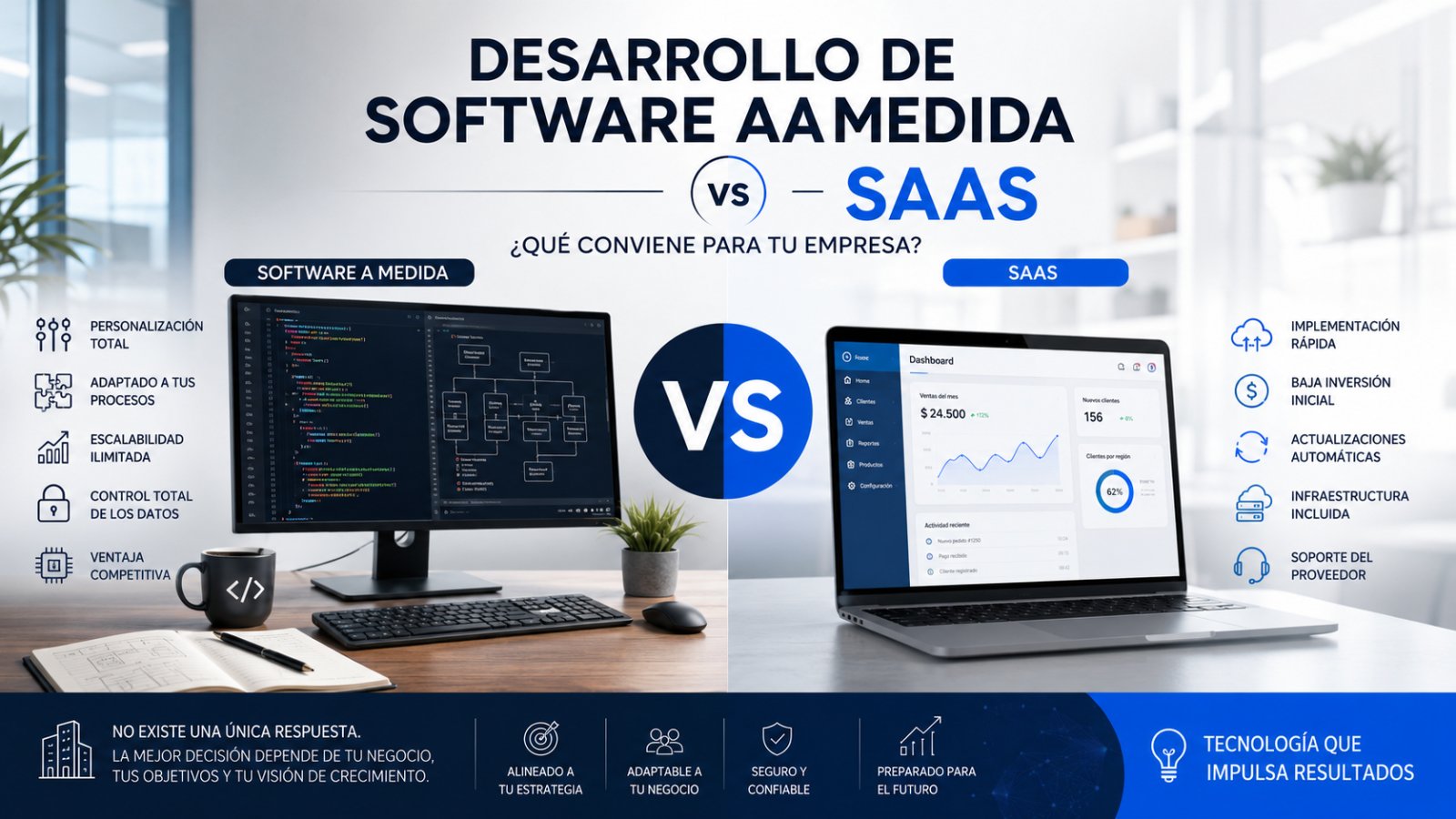
Custom Software Development vs SaaS: Which Is the Best Choice for Your Business?
Learn the differences between SaaS and custom software development to choose the solution that best supports your company's growth.
11/07/2026
We build the modules your ERP does not cover and integrate them with the system you already run, without replacing it.
A custom ERP is not about replacing the system you already run. It is about building the part of your operation that no standard ERP models, and integrating it with the core that already invoices, keeps the books and runs payroll. Most companies that call us do not want to throw away their ERP: they want to stop propping it up with spreadsheets.
The symptom is always the same and it is easy to spot. There is a process the ERP does not cover — a settlement formula of your own, a rate that depends on the route, batch traceability, a commission scheme that changes per client — and someone solved it in a spreadsheet on the side. That spreadsheet has grown, one person maintains it, and its numbers no longer match the system.
The cost is not the spreadsheet: it is that the important data lives outside the ERP. It cannot be audited, it cannot be reported without rebuilding it by hand, and it cannot scale, because every new client adds another tab.
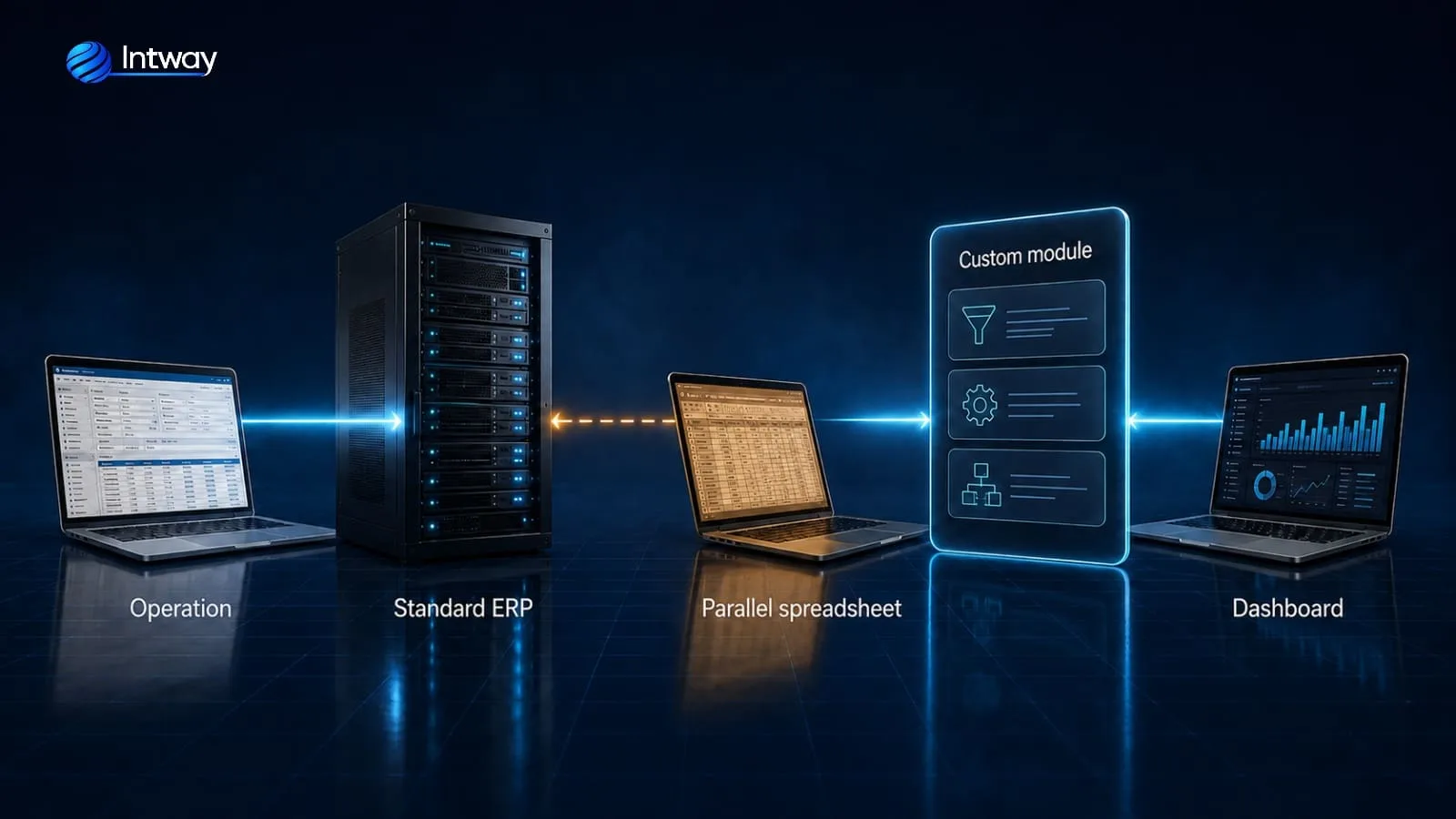
Extending makes sense when the ERP handles the standard well — accounting, taxes, payroll — and the gap sits in one or two business processes. Those modules get built, integrated through APIs, and the core remains the system of record.
Building from scratch makes sense when the product does not model the central object of your operation. If three modules have to be forced to represent something that is a single thing in your business, customization becomes more expensive than development, and every vendor update breaks it.
Is a critical process living in a spreadsheet next to your ERP? Tell us which one and we will tell you whether to extend or build.
| Need | Standard ERP | Custom module |
|---|---|---|
| Accounting, taxes, payroll | This is what it does best: use it | Unnecessary |
| The process that makes you different | Ends up solved in parallel spreadsheets | Exactly what it is for |
| Changes when the business changes | Subject to the vendor roadmap | Your priority |
| Vendor updates | Break whatever was customized inside the ERP | Code stays outside the core; compatibility is validated before each update |
Doing it with an in-house team is viable if you have one; the risk is the development losing its owner when that person leaves.
What an ERP fails to cover changes by sector, and that is the part worth building. In logistics and transport it is routes, per-leg rates and driver settlements. In healthcare, clinical records and billing to insurers with rules per agreement. In banking and financial services, proprietary products and the traceability the regulator demands.
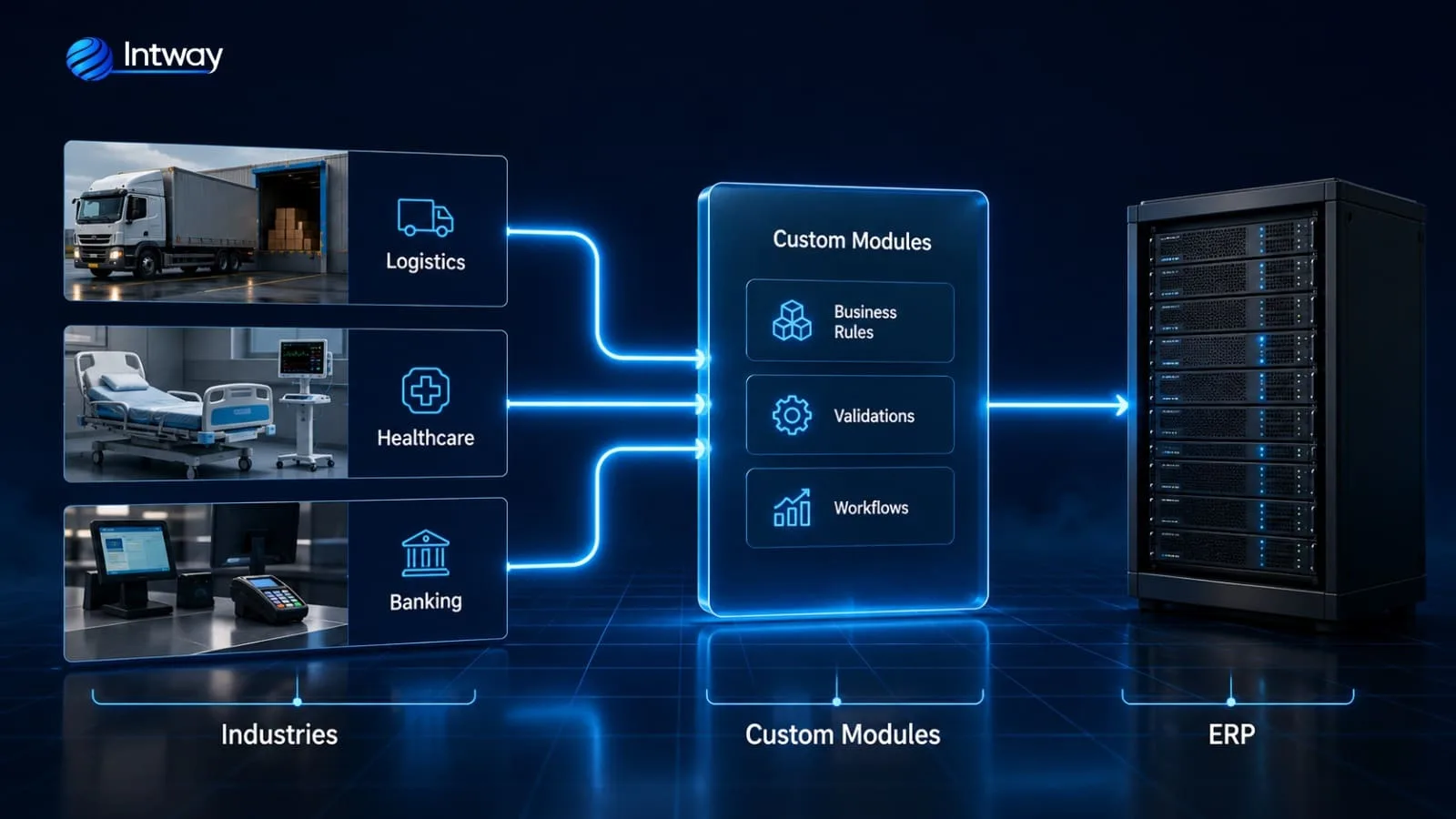
This is the question everyone asks after being burned by customizing inside the product. The answer lies in where the code lives: if the custom module sits outside and talks through APIs, an ERP update does not touch it. What can change is the API contract, which is why integrations are versioned and tested against a vendor environment before rolling out.
Not as a chatbot bolted on top. In three specific places where a person is currently doing mechanical work. The first is document entry: supplier invoices, delivery notes and orders arriving by email in different formats that someone types in. A model extracts the fields, business rules validate them, and only exceptions reach a review queue.
The second is anomaly detection: an entry outside the historical range, a price that does not match the purchase order, a consumption figure twice last month's. The system flags the case before it hits the closing, not after.
The third is querying: asking in natural language about the ERP data and getting the answer with the detail backing it, instead of waiting for a report. In all three the AI proposes and the rules decide: it never writes to the system of record on its own. We approach it the same way we do in AI process automation.
Cost is driven by the scope of the first module, how many integrations it needs, how many users and roles must be covered, the state of the data being migrated from spreadsheets, and where the infrastructure runs. We estimate after mapping the process and separating the essential core from what can wait for a second stage, so the proposal reflects real work and verifiable acceptance criteria. Tell us about your case and we will scope it.
| Initial situation | What we built | Outcome |
|---|---|---|
| Supplier settlements were calculated in a spreadsheet that did not match the ERP | An in-house calculation engine, API-integrated, with versioned rules | Closing went from 3 days to 4 hours, every rule auditable |
| Each branch kept its own stock file | A custom inventory module synchronized with the ERP | Stock discrepancies from 12% to 1.5% within three months |
| Board reports were assembled by hand every month | A dashboard fed from the ERP and from the new modules | From 2 days of manual assembly to available in 1 hour |
If you are still coming out of spreadsheets and have no ERP installed, the starting point is different: see custom software for SMEs.

We build the modules your ERP does not cover and integrate them with the system you already run, without replacing it.
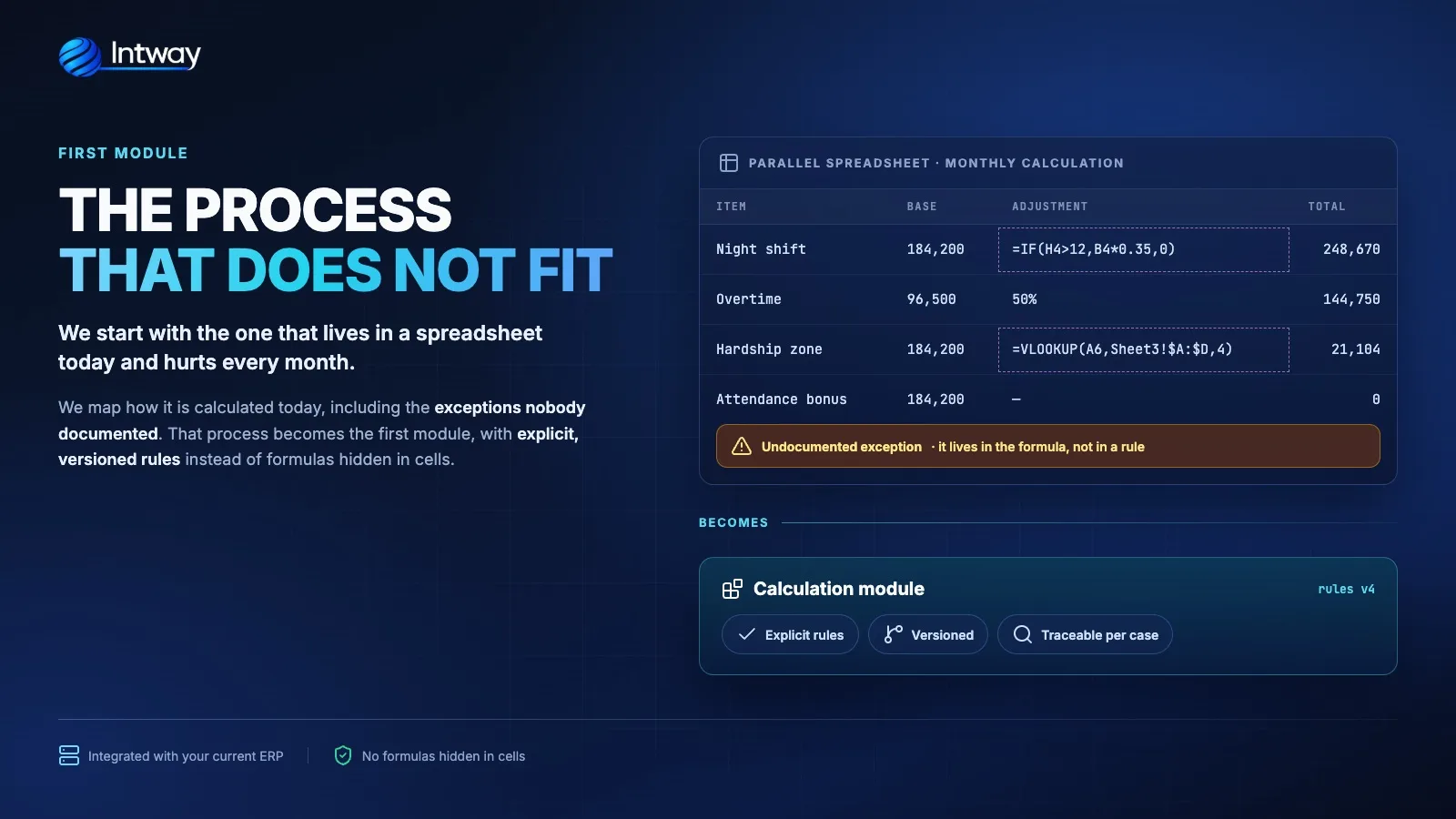
We start with the one living in a spreadsheet that hurts every month.
Ver más →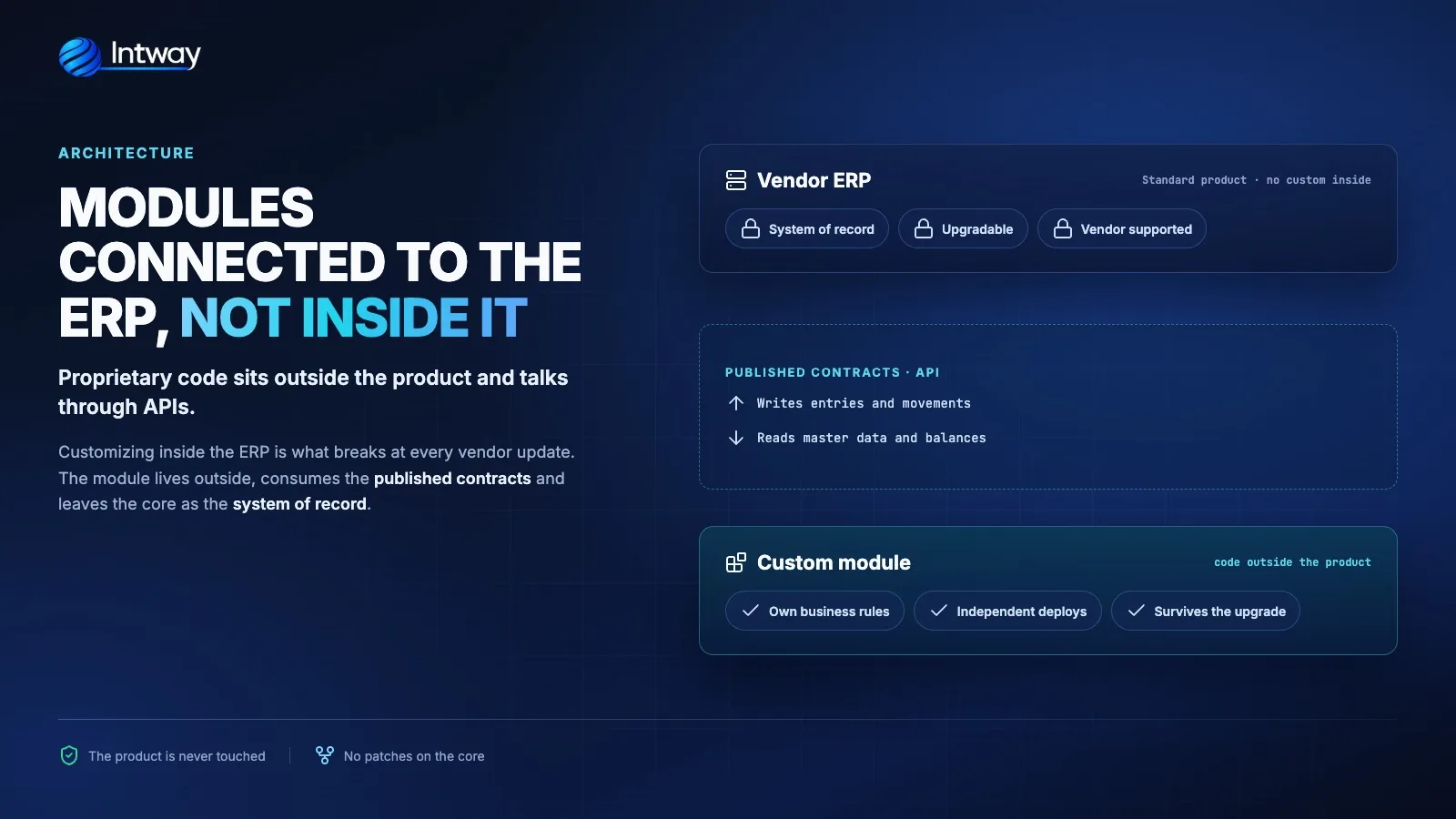
Proprietary code sits outside the product and talks through APIs.
Ver más →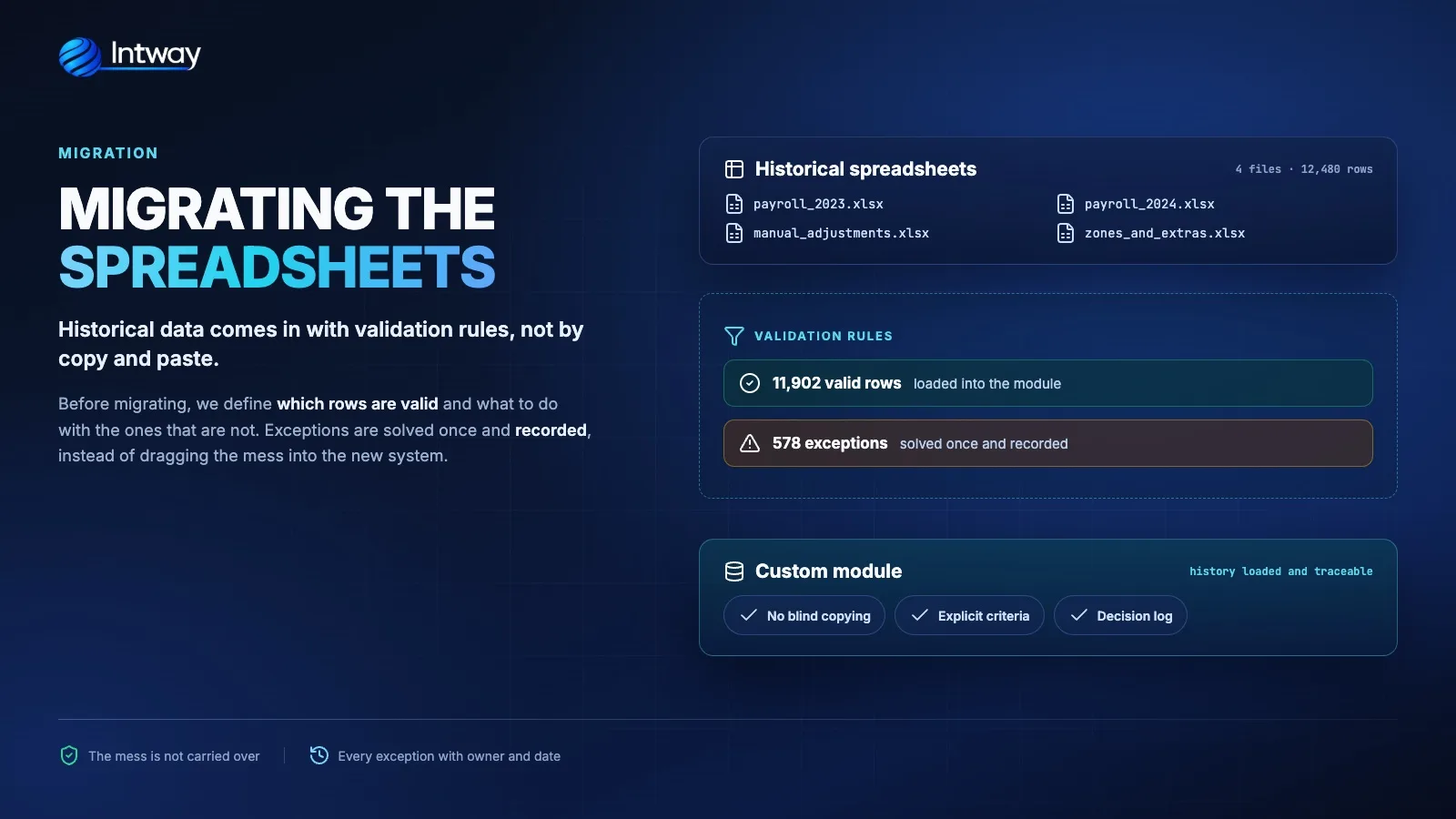
Historical data enters through validation rules, not by copy and paste.
Ver más →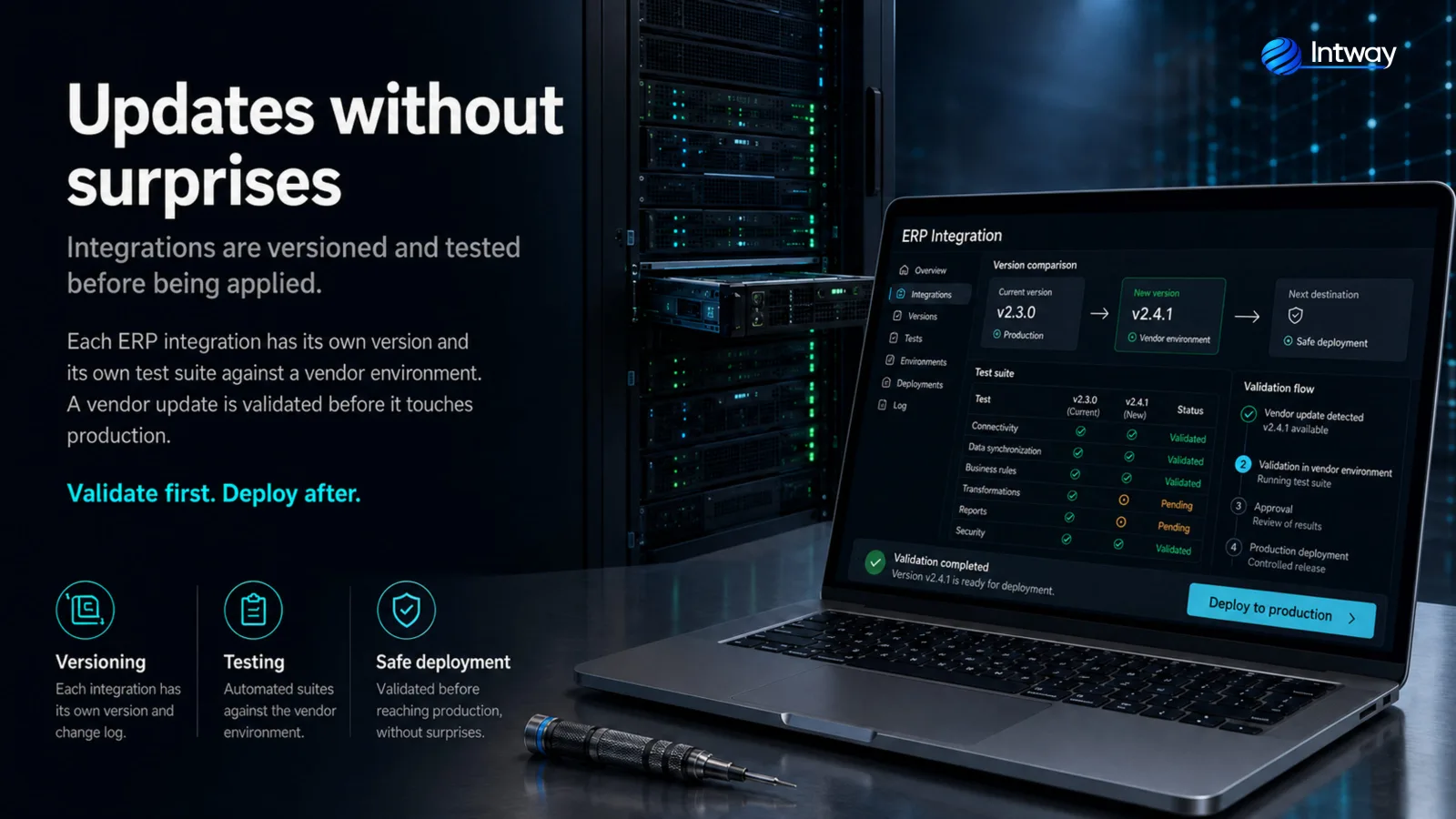
Integrations are versioned and tested before they are applied.
Ver más →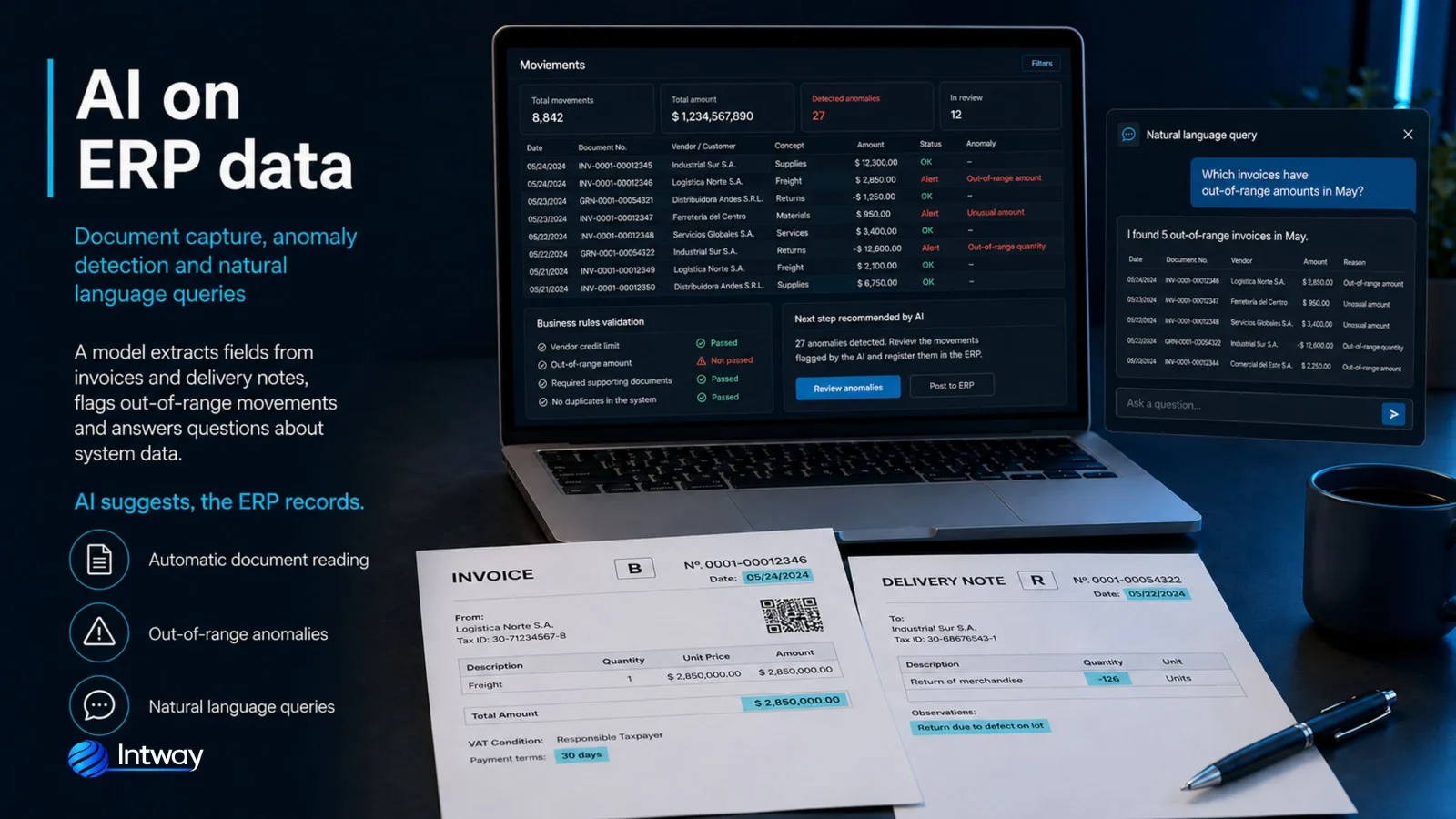
Document entry, anomaly detection and natural-language querying.
Ver más →We build the proprietary part of your operation and integrate it with the system you already use.
The process the system does not cover ended up in a file one person maintains. We model it and integrate it back into the operational flow.
Settlement formulas, per-route rates, batch traceability or rule-based commissions: whatever is specific to your business.
We integrate the ERP with the new modules, the e-commerce and internal tools through APIs, with retries and a record of every change.
With its exceptions and shortcuts, not the one in the manual. We define what gets measured before and after.
On real data, to validate the calculation against what the spreadsheet does today.
Versioned contracts, permissions, a record of every change and handling for communication failures.
The old process runs alongside during the first closings, with adjustments driven by what shows up in production.
No. In most projects the ERP stays as the system of record and the custom work covers the process the product does not model. A full replacement is only considered when the ERP cannot represent the central object of the business.
An update does not modify the external module's code, but it can affect the integration: APIs, authentication, schemas or behavior may change. That is why we version the contracts and validate all of it in a test environment before updating production.
Yes, and with in-house systems too. Integration happens through whatever APIs or exchange mechanisms each product exposes. Before committing to scope we verify which operations the ERP publishes and with what limits.
They are mapped, validated and migrated with explicit rules. Rows that do not comply land in a review queue instead of entering the system. During the first closings the old process can run alongside the new one.
It depends on scope, how many integrations it needs and the state of the data being migrated. After discovery we provide scope, acceptance criteria and a committed timeline instead of a generic estimate.
Yes. The module's code and the data belong to the company, with the repository and documentation handed over. Nothing is tied to a license of ours or to a proprietary platform.
Tell us which one it is and we will assess whether to extend your ERP or build the module separately.
Contact us