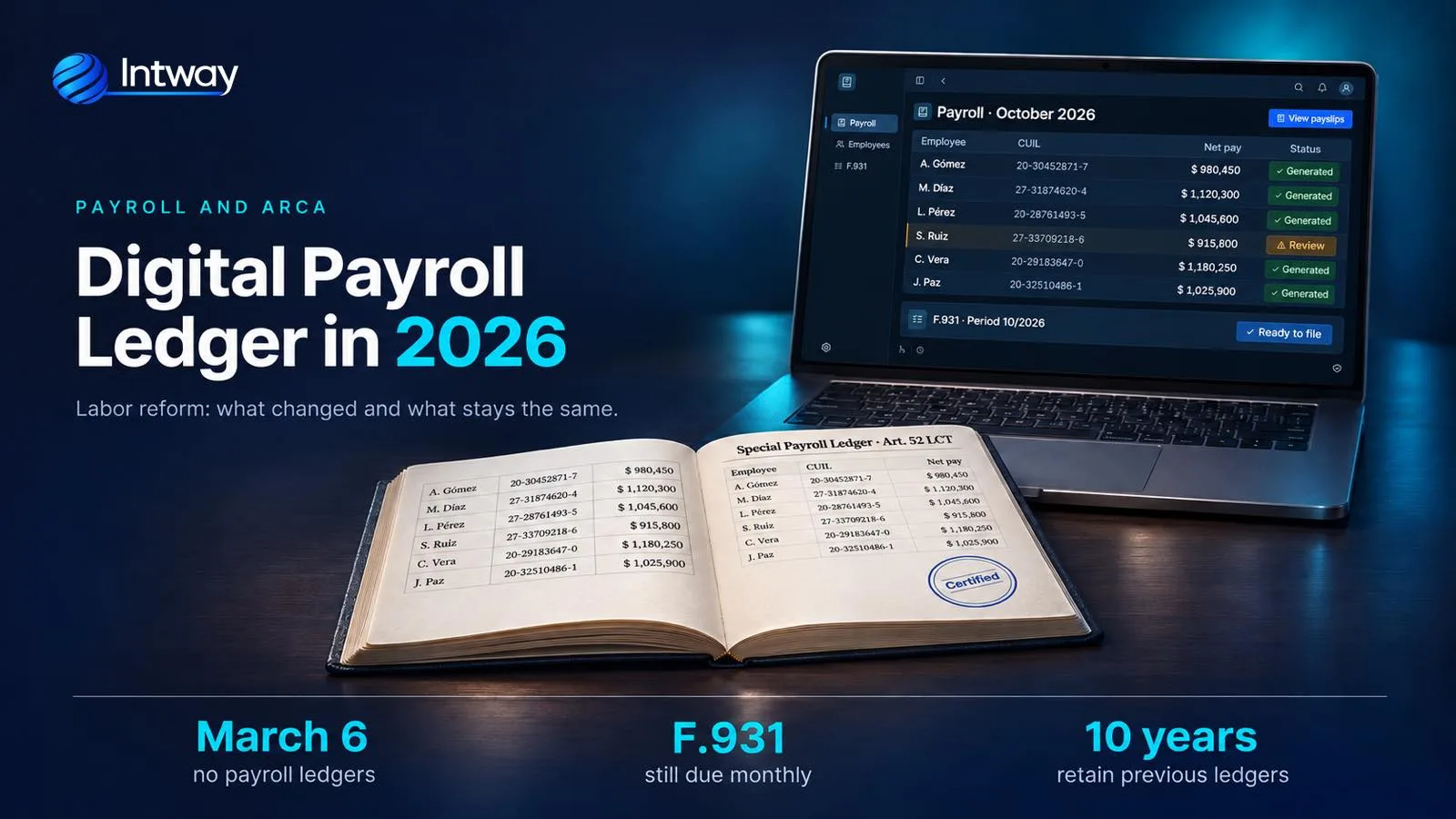
Argentina's Digital Payroll Book (Libro de Sueldos Digital, LSD) is the ARCA service where employers load each month's payroll. For years it did two jobs at once: it was the digital version of the special payroll book required by article 52 of the Employment Contract Law, and it was the step before building the social security return (form F.931). In 2026 the labor reform changed the first part: since March 6, employers are no longer required to keep labor books, on paper or digital. The second part, the monthly return, remains.
This guide explains what the Digital Payroll Book is, what changed with Law 27,802 and Decree 407/2026, what stays the same and how to connect your payroll system so the same data isn't loaded twice.
What the Digital Payroll Book is
It's an ARCA service accessed with the employer's tax key. The employer loads its employees' payroll (by hand or by uploading a file in the format ARCA publishes) and the service cross-checks that data with what it already has: hires and terminations from the employee registry and the online return. Once the employer approves the payroll, the data flows into the F.931 return, which is filed and paid as always.
A key part of the service is pay items. Each company pays with its own items (base salary, overtime, attendance bonus, a performance bonus) and each one is mapped to an item on a list defined by ARCA. That mapping says whether the item counts toward pension, health insurance or occupational risk. If an item is mapped wrong, the error flows into the contributions of every employee who receives it.
Who had to use it until 2026
The service didn't reach everyone at once. ARCA (formerly AFIP) made it mandatory in stages, by industry and by province, and notified each employer through its electronic tax address. Joint General Resolution 5249 of 2022, from AFIP and the Ministry of Labor, set that phased rollout. Because each province's labor authority used to stamp the payroll book, ARCA signed agreements with the provinces so the digital version would replace the paper stamp.
Even so, since not every province joined, until the 2026 reform many companies lived with two things: the Digital Payroll Book for the return and, in some provinces, their own stamping procedures.
What changed with the labor reform
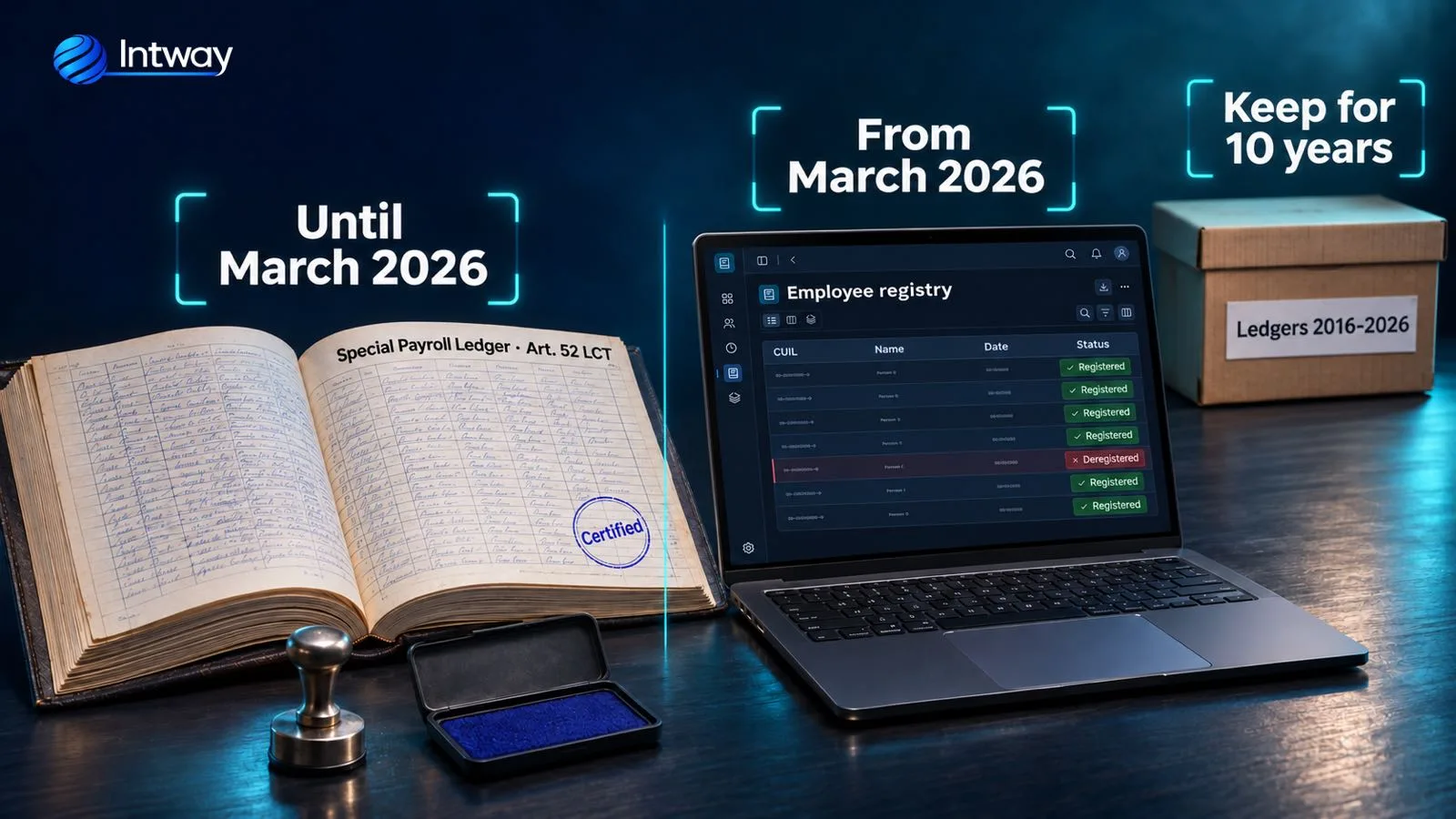
Labor Modernization Law 27,802, published on March 6, 2026, rewrote article 52 of the Employment Contract Law: employers register their workers with ARCA and that registration is sufficient for all purposes. Decree 407/2026, in force since June 1, 2026, set the details: registration is done by recording hires and terminations in ARCA's systems, no other administrative authority may require anything additional, and employers are not required to keep labor books on paper or in digital form.
The decree states that all of this applies from the date the law came into force, that is, since March 6, 2026. What started on June 1, with the decree, is the new payslip model.
| Topic | Before the reform | Since March 6, 2026 |
|---|---|---|
| Worker registration | Registration with ARCA plus the article 52 special book | Hires and terminations in ARCA's systems, nothing else |
| Payroll book | Mandatory, stamped on paper or in the Digital Payroll Book | Not required, on paper or digital |
| Provincial stamping | Depending on the province | No other administrative authority may require anything additional |
| Earlier books | Kept | Kept for ten years; can be digitized with the same validity |
| Payslip | Free format with minimum content | Four-section model set by Decree 407, since June 1 |
| F.931 | Monthly | Monthly, unchanged |
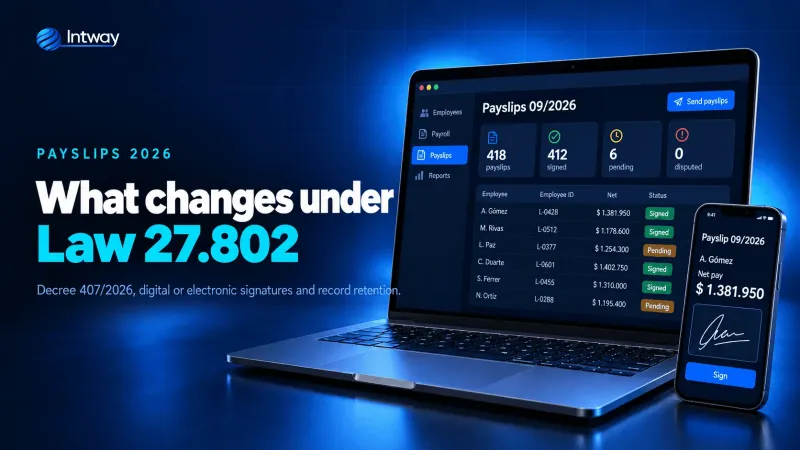
The payslip changed too: since June 1 it must follow the decree's four-section model, including the contributions paid by the employer. We cover it in detail in our guide to the Argentina digital payslip 2026.
What stays the same and what's new in the F.931
Dropping the book doesn't remove the monthly return. The F.931 is still filed and paid, and its figures have to match the payslip. The resolutions that govern the Digital Payroll Book service (General Resolutions 5249 and 5250 of 2022) are still in force, employers who use it still build the F.931 there, and in 2026 ARCA kept publishing guides for it: guide 56 explains how to report employees under the Labor Formalization Incentive Regime in the payroll (code 710 on the F.931, for hires between May 1, 2026 and April 30, 2027).
In addition, the Labor Assistance Fund is reported from the December 2026 accrual period, and from December 1 returns are filed with version 48 of the online return. Before you stop using the service, or change how you build the return, confirm it with your accountant: the law removed the book, not the return.
How to integrate your payroll system
If you run payroll in your own system or a purchased one, the data is already there: there's no point loading it again on ARCA's website.
An example: a company with six employees runs its October 2026 payroll with base salary, overtime, attendance bonus, vacation pay and a performance bonus, all five mapped to their ARCA item. The October F.931 comes out with the same six employees and the same figures as the payslips, and with code 710 for the one hired under the Labor Formalization Incentive Regime.
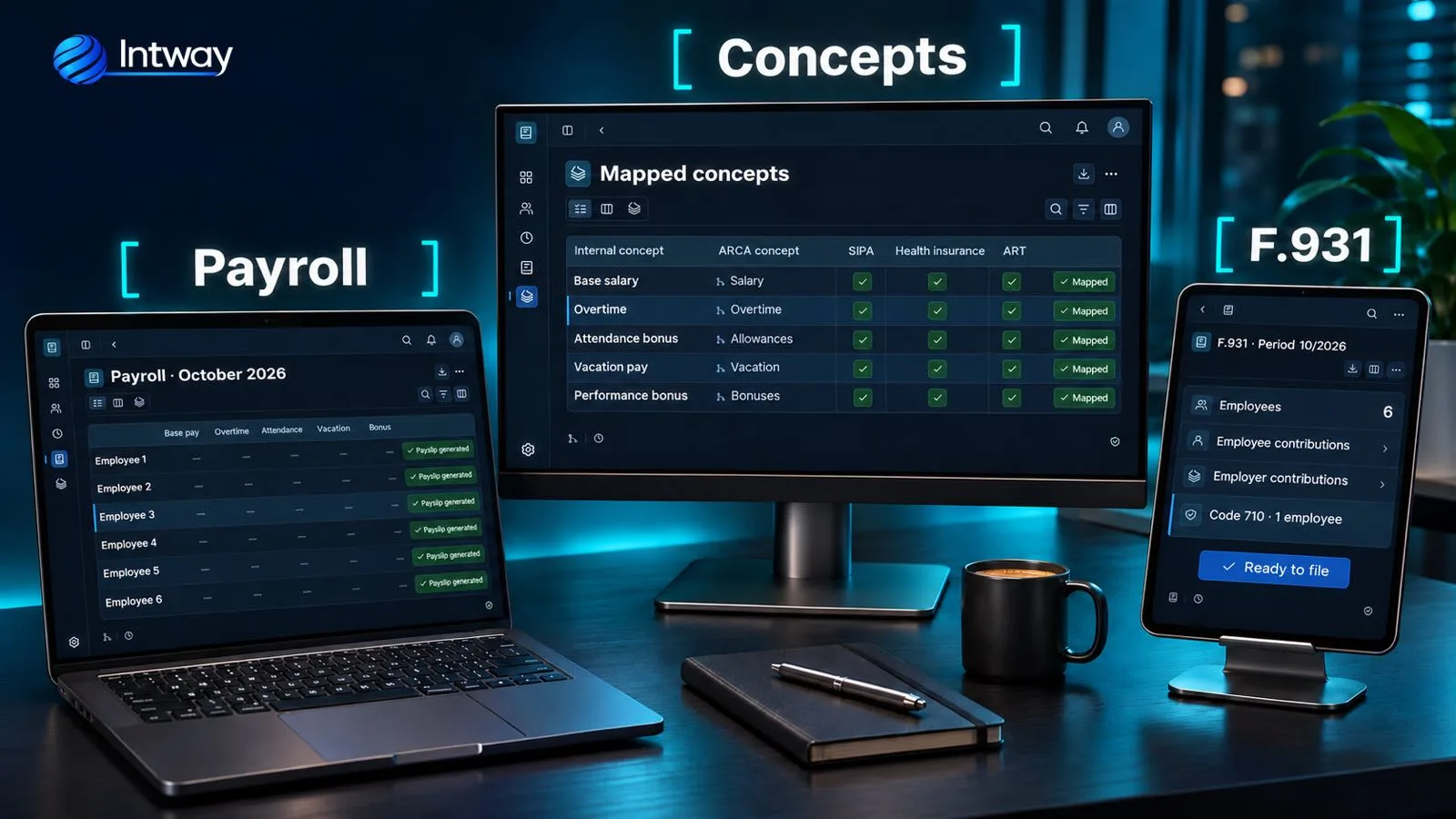
- One payroll run. The payslip, the ARCA file and the accounting entries come from the same calculation. If something is corrected, it's corrected in the system and everything is generated again.
- Items mapped once. Each of your items stays mapped to its ARCA item inside the system, with who approved it and since when. A new item, such as a bonus, can't be paid until it has its mapping.
- A file in ARCA's format. The system generates the payroll file in the layout ARCA publishes and validates it before upload: registered employee IDs, mapped items, totals that match the payslips.
- Rule changes inside the system. Code 710, the Labor Assistance Fund or a new version of the return are added to the system as rules with an effective date, not as separate spreadsheets.
- Hours from time tracking. If overtime comes from the clock, payroll takes it from the punch, not from a spreadsheet. That's what more than 300 companies do with the face recognition time and attendance software.
- An orderly archive. Earlier books are kept for ten years, on paper or digitized; payslips, for the period the law sets. With digital payslip signing, delivery and archive live in the same place.
Common mistakes
- Assuming the F.931 is gone too. What was removed is the book, not the return.
- Throwing away earlier books. They are kept for ten years.
- Wrongly mapped items. A bonus mapped as non-wage when it isn't changes the contributions of everyone who receives it.
Checklist
- Does your system generate the payslip, the ARCA file and the entries from the same payroll run?
- Does each item have its ARCA item mapped, with a control for new ones?
- Does the system validate the file before upload?
- Does it report code 710 for hires under the Labor Formalization Incentive Regime?
- Does it declare the Labor Assistance Fund from the December 2026 accrual period?
- Are earlier books kept for ten years, on paper or digitized?
- Does the payslip follow the four-section model?
How Intway can help
We build and modernize payroll systems. We replaced a Visual Basic payroll engine with a multi-country cloud platform, and we connect time tracking with payroll. If your payroll lives inside a management system, we can integrate it as part of a custom ERP; how it connects with payslip signing is defined in each project.