Custom Software for Logistics, Transportation and Last Mile
We build custom software for logistics and transportation: TMS, WMS, fleet management and real-time tracking, integrated with your current systems.
Logistics is a thin-margin business where every delay, every lost shipment and every piece of data keyed in twice turns into cost. In that context, logistics and transportation software has stopped being a support tool and become the nervous system of the operation: it coordinates warehouses, fleets, routes and deliveries, and connects the company with its customers, its carriers and its sales channels. When that software works well, the operation scales; when it fails or is disconnected, every demand peak feels like a crisis.
At Intway we have been building, integrating and modernizing custom software for logistics, transportation and distribution companies for more than 25 years. We work with logistics operators, transport and fleet companies, distributors, e-commerce businesses that handle their own delivery, and industrial companies that move their production every day. This page explains what we build, when each approach makes sense and how we tackle it, so a company looking for a technology partner knows exactly what to expect.
What is logistics and transportation software?
That label covers very different solutions that address different parts of the chain. A TMS (Transportation Management System) manages transport: trip planning, vehicle and driver assignment, freight tracking and carrier settlement. A WMS (Warehouse Management System) manages the warehouse: receiving, locations, inventory control, picking, packing and dispatch. Around them come route optimization, end-to-end tracking, fleet management, the driver app, proof of delivery and control dashboards. You rarely need all of it at once: the smart move is to start where the biggest cost or the worst friction is.
When does custom development make sense?
Not always. When an off-the-shelf product fits the process well, integrating it is the best decision. Custom development is justified when the operation has its own rules that no product covers, when you need to connect systems that were never meant to talk to each other, or when the competitive edge lies precisely in how goods move. In those cases, forcing a closed product ends up costing more —in licenses, customizations and manual work— than building exactly what the operation needs. That is why we combine system integration with custom development depending on what adds the most value in each case.
The real problem: systems that don't talk to each other
The most common pain in logistics is not a lack of software, but an excess of disconnected software. The ERP doesn't talk to the WMS, the WMS doesn't talk to the TMS, the e-commerce generates orders that someone re-keys by hand, and every carrier has its own portal. The result is duplicated data, dispatch errors and zero visibility. Solving this doesn't require replacing everything, but integrating: exposing each system through APIs, orchestrating the flow with messaging and events, and ensuring that a piece of data is entered once and travels without getting lost or duplicated.
How we approach it
We start with the operation, not the technology. We map the real flows, measure the KPIs that matter —cost per shipment, SLA compliance, stockouts, preparation time— and pinpoint where money leaks. Only then do we design the architecture: we define the integrations, choose between event-driven architectures and microservices depending on volume and real-time needs, and plan a phased go-live that doesn't stop operations. We develop with quality controls —testing, code review and iterative releases— and, once in production, we keep optimizing based on real data.
Applied AI in logistics, no hype
Artificial intelligence adds real value when it improves a concrete decision. We use it for predictive ETA (accurately estimating when a shipment will arrive), demand forecasting by zone and season to size fleet and stock, route optimization and anomaly detection that flags a breach before it happens. We don't pitch AI as a slogan: we bring it in where your operational data makes it possible to make better decisions and cut costs.
Common mistakes we avoid
Some patterns repeat and make projects more expensive. The first is trying to replace everything at once with a "big bang" project instead of moving in low-risk stages. The second is buying a closed product without assessing the real cost of adapting it to the operation. The third is leaving scalability for later and discovering, in the middle of peak season, that the platform can't handle the load. And the fourth, perhaps the most expensive, is building without traceability: without data and events, you can't improve what you can't measure.
Technologies and architecture
We choose technology based on the problem. On the backend we work with Java, Spring Boot, Node.js, NestJS and .NET; on the frontend with React, Angular and Next.js; on mobile with React Native for driver and customer apps; with SQL Server, PostgreSQL, Oracle and MySQL databases; in the cloud with AWS, Azure and Google Cloud; and for integrations with REST, EDI, GraphQL, RabbitMQ and Kafka. In architecture we prioritize real time and scalability where the operation demands it, without adding complexity that doesn't pay off.
Why Intway
We are a software factory with more than 25 years and over 500 projects delivered, with real experience in mission-critical, highly available software. We bring senior teams that integrate with the client's teams, scalable architecture, integration with existing systems —including legacy environments— and long-term evolutionary support. To go deeper into these topics, we invite you to read our Insights, where we share how we approach real-time visibility, system integration and modernization without disrupting operations.

Detalles
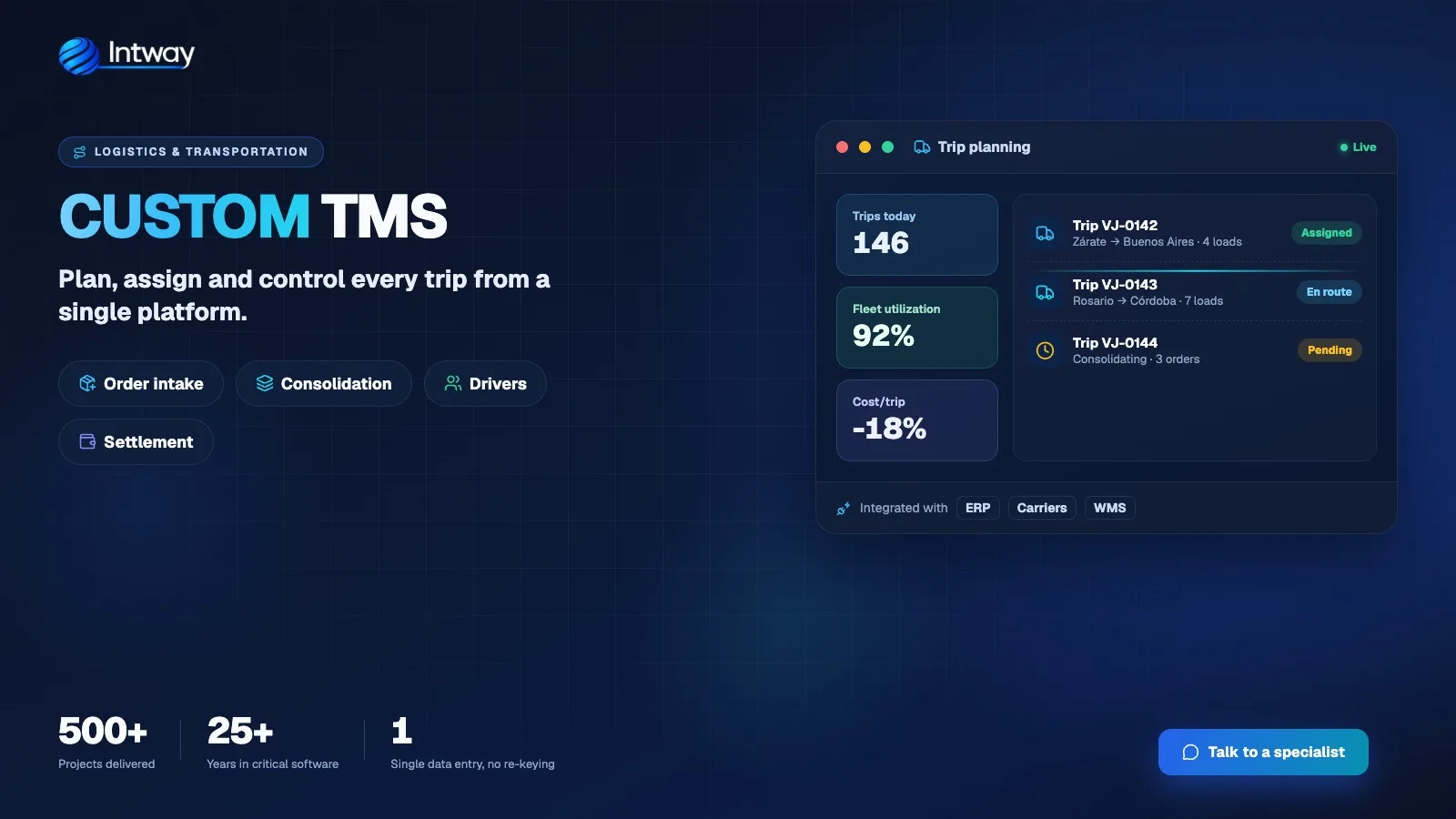
Custom TMS
Plan, assign and control every trip from a single platform.
Ver más →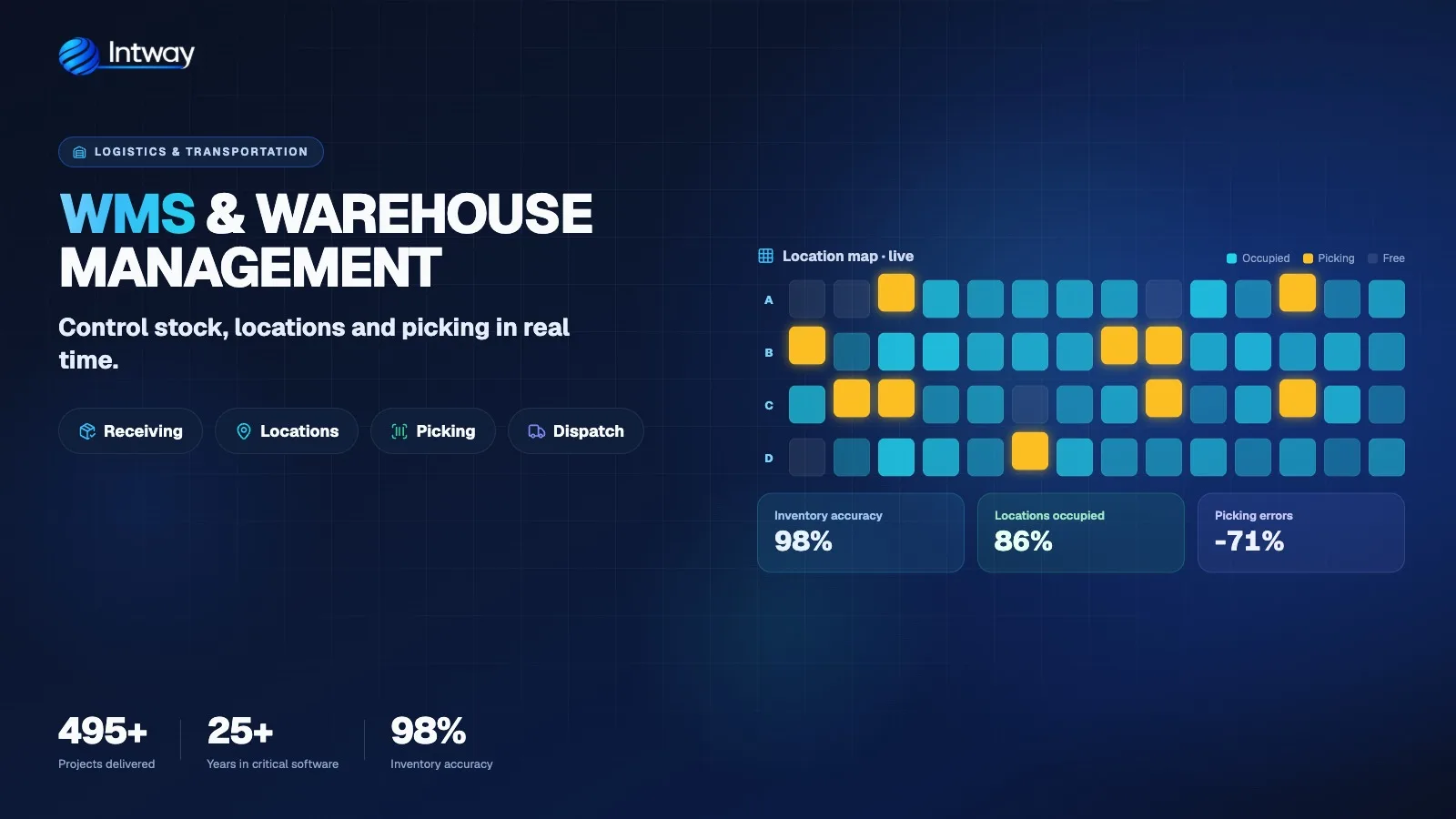
WMS and warehouse management
Control stock, locations and picking in real time.
Ver más →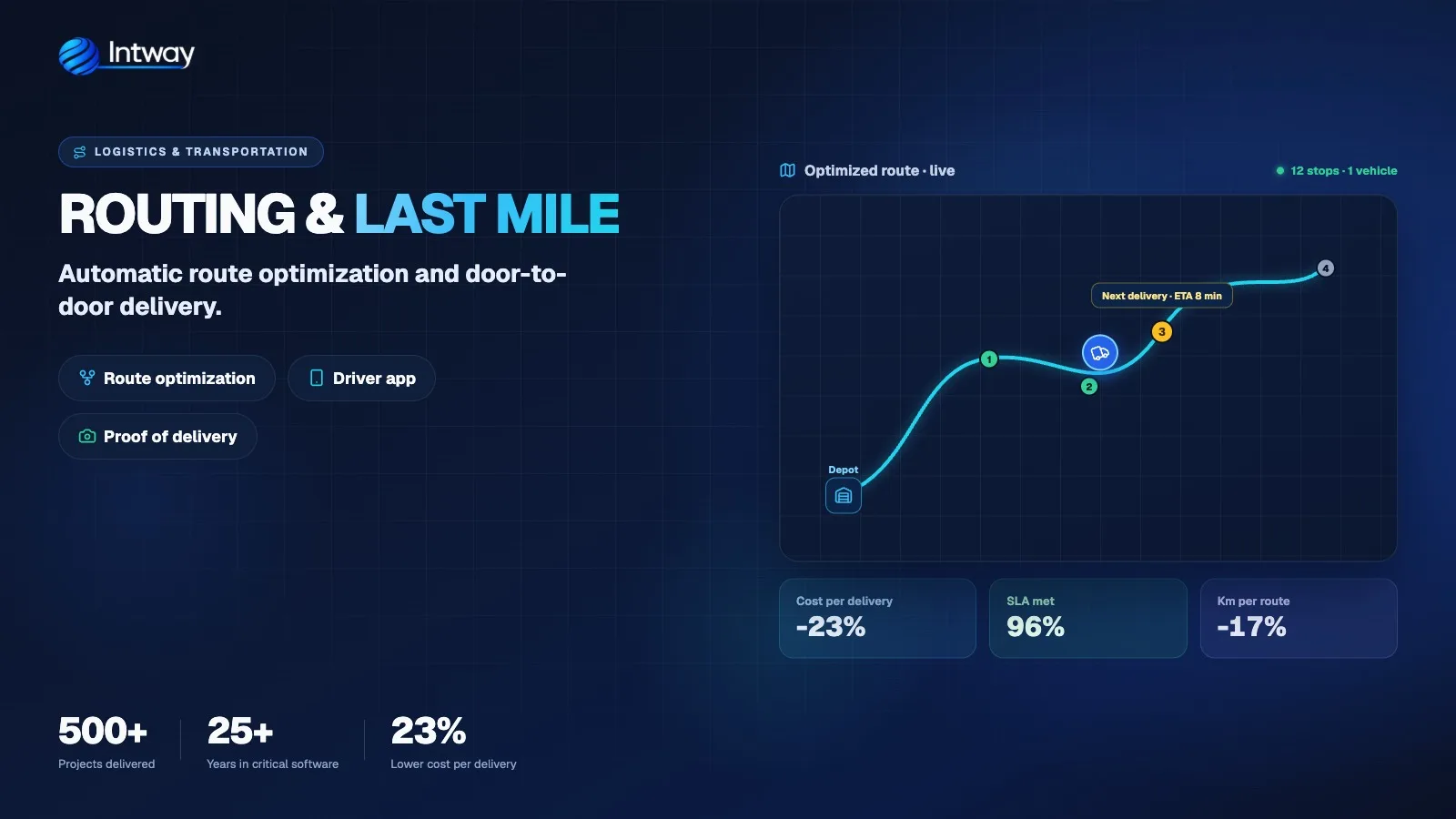
Routing and last mile
Automatic route optimization and door-to-door delivery.
Ver más →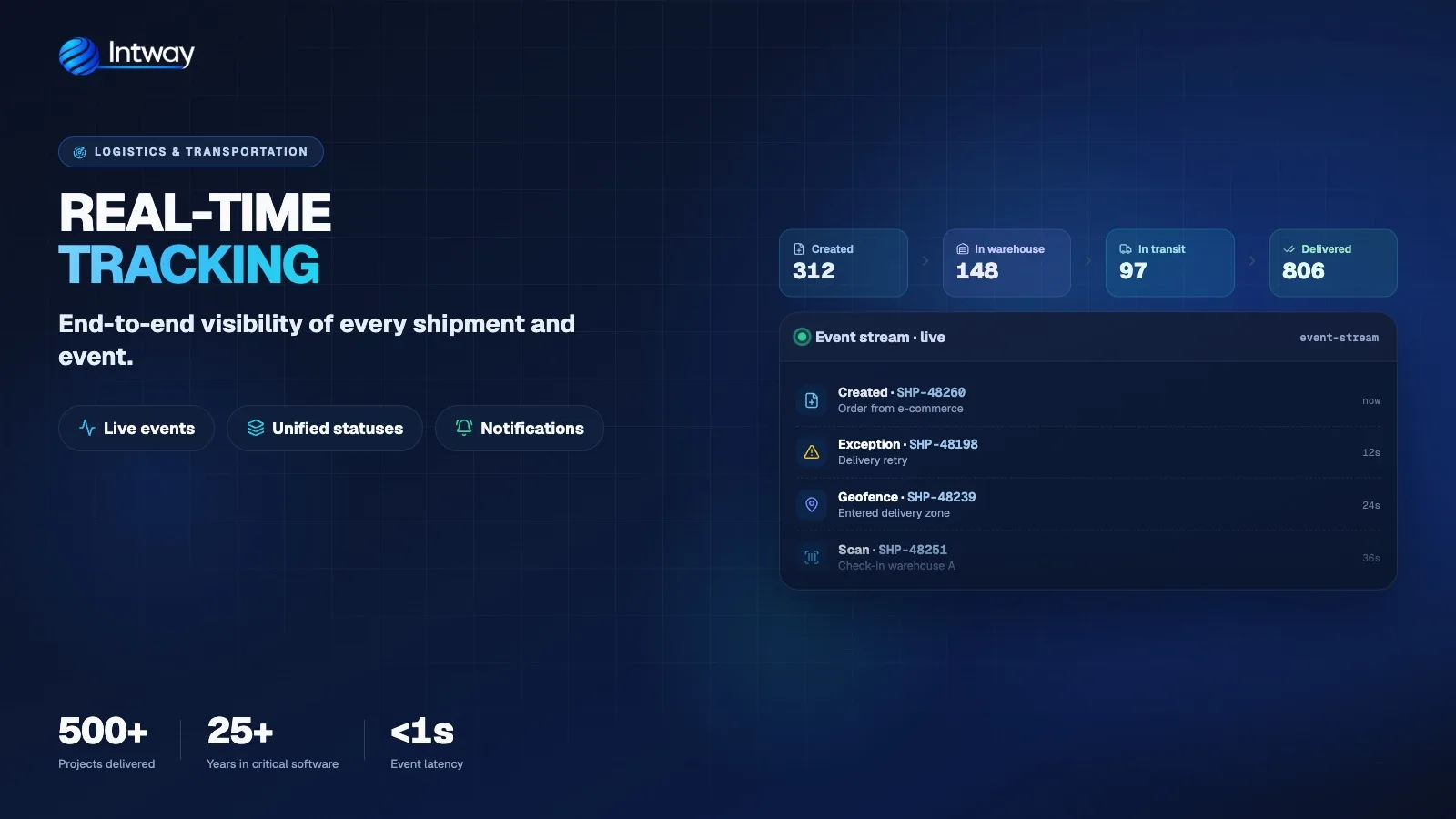
Real-time tracking
End-to-end visibility of every shipment and event.
Ver más →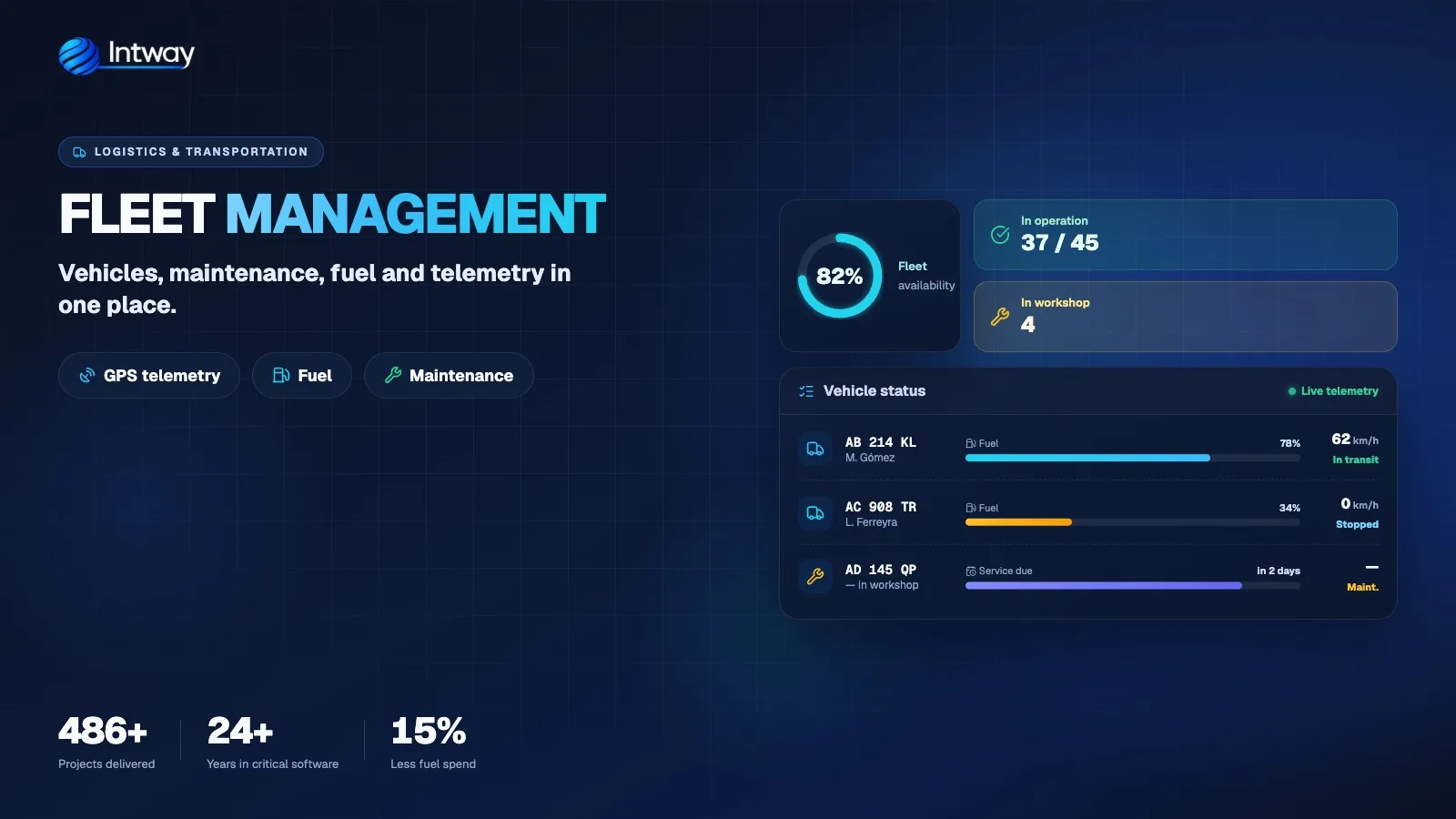
Fleet management
Vehicles, maintenance, fuel and telemetry in one place.
Ver más →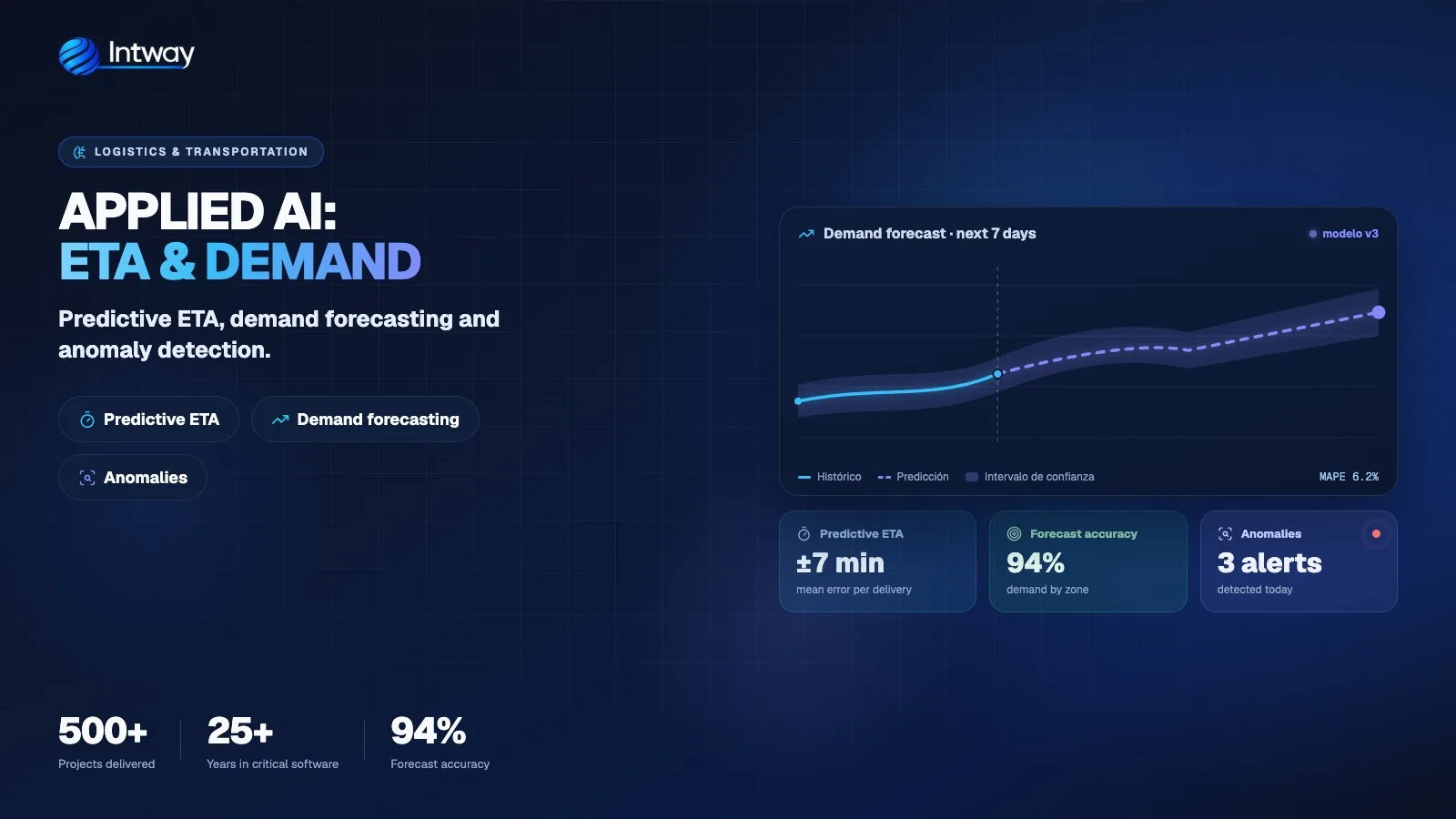
Applied AI: ETA and demand
Predictive ETA, demand forecasting and anomaly detection.
Ver más →What we solve in logistics and transportation
We don't propose technology for the hype. We tackle the concrete bottlenecks that make a logistics operation slower and more expensive.
Disconnected systems that don't talk to each other
The ERP, WMS, e-commerce and carriers live in isolation and force manual re-keying. We integrate them with APIs and messaging so data flows just once.
No real-time visibility
Nobody knows for sure where each shipment is. We build end-to-end tracking with events, dashboards and alerts for your team and the end customer.
Manual routing and planning
Planning trips and deliveries on spreadsheets is slow and costly. We automate routing with optimization that respects time windows, capacity and priorities.
How we work
Operations assessment
We map flows, systems and KPIs (cost per shipment, SLA compliance, stockouts) before writing a single line of code.
Architecture and integration design
We define APIs, events and integration layers without disrupting the running operation.
Development with quality controls
Testing, code review and iterative releases on every delivery.
Go-live and continuous improvement
Phased rollout, monitoring and optimization based on real operational data.
What is a TMS?
A TMS (Transportation Management System) is the system that manages transport: trip planning, vehicle and driver assignment, freight tracking, carrier settlement and cost control. It is the command center of a distribution operation.
What is the difference between a TMS and a WMS?
The WMS manages what happens inside the warehouse (stock, locations, picking, packing and dispatch), while the TMS manages what happens in transport (trips, routes, fleet and deliveries). They usually work integrated: the WMS prepares and the TMS moves.
Does it integrate with my ERP and carriers?
Yes. A large part of the work is integration: we connect with ERPs, e-commerce platforms, carriers and logistics operators through REST APIs, EDI and messaging, with retries and reconciliation so no information is lost or duplicated.
Do you build custom software or sell a closed product?
We build custom software. We build the solution around your real processes, or we integrate and extend the systems you already use, instead of forcing a standard product that doesn't fit your operation.
How do you optimize routes?
With optimization engines that account for time windows, vehicle capacity, zones, priorities and business constraints. The goal is to lower cost per delivery and meet the SLA, with automatic planning instead of spreadsheets.
Let's talk about your logistics operation
Tell us which part of your logistics is slowing you down and we'll assess together what can be solved, with a concrete proposal.
Contact us