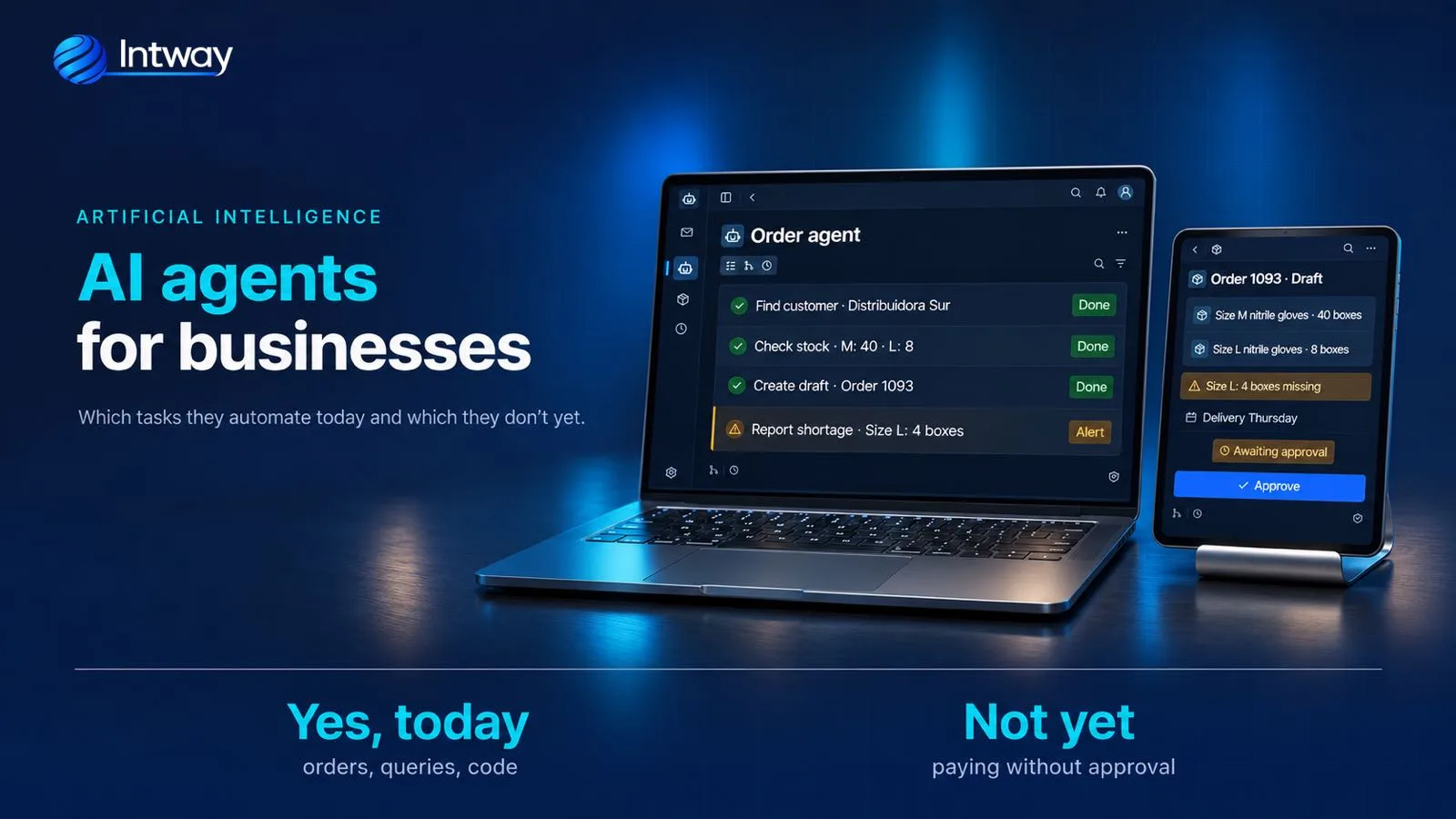
An AI agent is a system that uses a language model to decide which steps to take and which tools to use until a task is done: it queries a system, reads a document, prepares an action and stops when it is finished or when it needs a person. Today almost any AI product is sold as an agent. This guide brings it down to earth: which business tasks an agent handles well today, which ones it is still too early to hand over, and how to implement one with controls. If you are still choosing between an automation workflow, an agent or custom development, start with our guide to AI process automation.
What an AI agent is, and what it isn't
OpenAI's practical guide to building agents defines it by two traits: the model runs the task (it knows when it is done, corrects itself and, if it fails, hands control back to the person) and it uses tools to query and act on other systems. So a chatbot that only talks, a single model call or a sentiment classifier are not agents.
The distinction matters when buying. In June 2025, Gartner estimated that of the thousands of vendors claiming to offer agents, about 130 really do; the rest are assistants, chatbots or automation tools under a new name. In the same report it predicted that over 40% of agent projects will be canceled by the end of 2027, due to escalating costs, unclear business value or inadequate risk controls.
Four conditions for giving a task to an agent
- The path changes from case to case. If the steps are always the same, a fixed workflow does it for less. Anthropic's guide keeps agents for open-ended problems, where you can't predict how many steps it will take.
- Each case has to be interpreted. An email, a PDF or a question written any which way: fixed rules fall short, and what it says changes the next steps. If you only need to pull data out of a text, a single model call inside a workflow is enough.
- You can check whether it went right. A resolved complaint, a passing test, an order that matches stock. Without that, errors go unnoticed.
- What it does can be undone or goes through a person. A draft, a proposal, a reply someone reviews.
AI agent use cases: tasks an agent handles well today
Customer service
It is one of the two uses Anthropic singles out as particularly promising: the conversation needs customer data, order history and help articles, and success is measured by resolution. An agent answers where an order is, what an invoice says or when a plan expires, opens or updates the ticket and hands off to a person when it can't solve it. If the case calls for a refund, it proposes it; it doesn't pay it.
Orders and documents that arrive as text
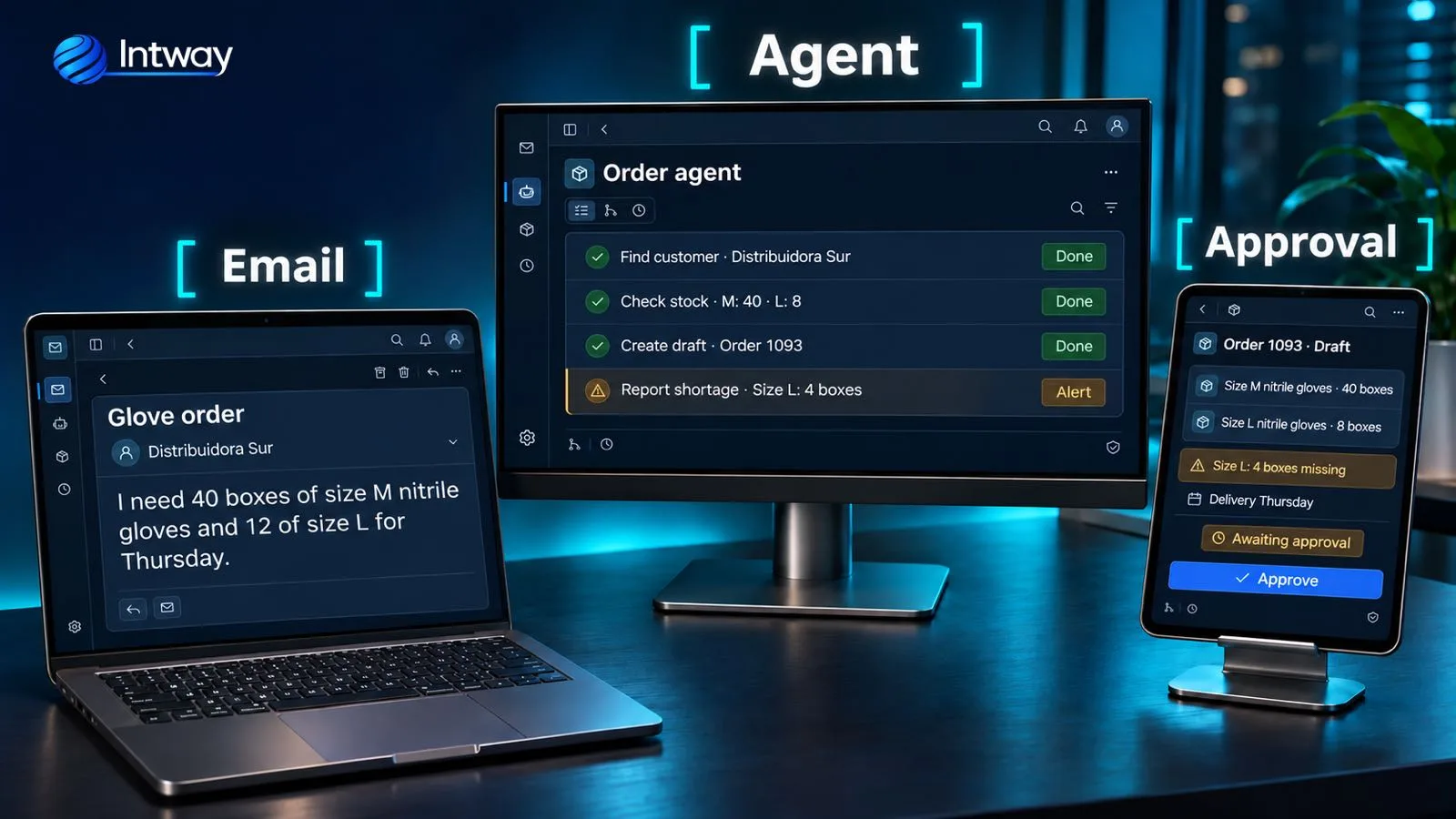
A fictional example: Distribuidora Sur emails "I need 40 boxes of size M nitrile gloves and 12 of size L for Thursday". The agent looks up the customer, checks stock (40 boxes of M and 8 of L), creates order 1093 as a draft, flags that 4 boxes of size L are missing and leaves it "Awaiting approval". A person approves the draft, and only then is the order confirmed to the customer. If every order arrived the same way, a workflow would do. The agent earns its place because each email is different: a customer signing with another name, a product described their own way, a shortage that means checking when stock comes in. The same goes for purchase orders in PDF or delivery notes.
Questions across several systems
"How much did we sell this customer this quarter and what do they still owe?" means looking at the ERP and the CRM. An agent with read-only access to both puts the answer together. When the question is about manuals, contracts or procedures, the foundation is AI on your company's data with RAG.
Cases with exceptions
OpenAI's examples are approving a refund with judgment, reviewing a vendor's security or processing an insurance claim: nuanced decisions, rulesets too complex to maintain cheaply, or lots of unstructured text to interpret. The agent gathers the information, applies the policy and proposes a decision that a person confirms.
Code and systems
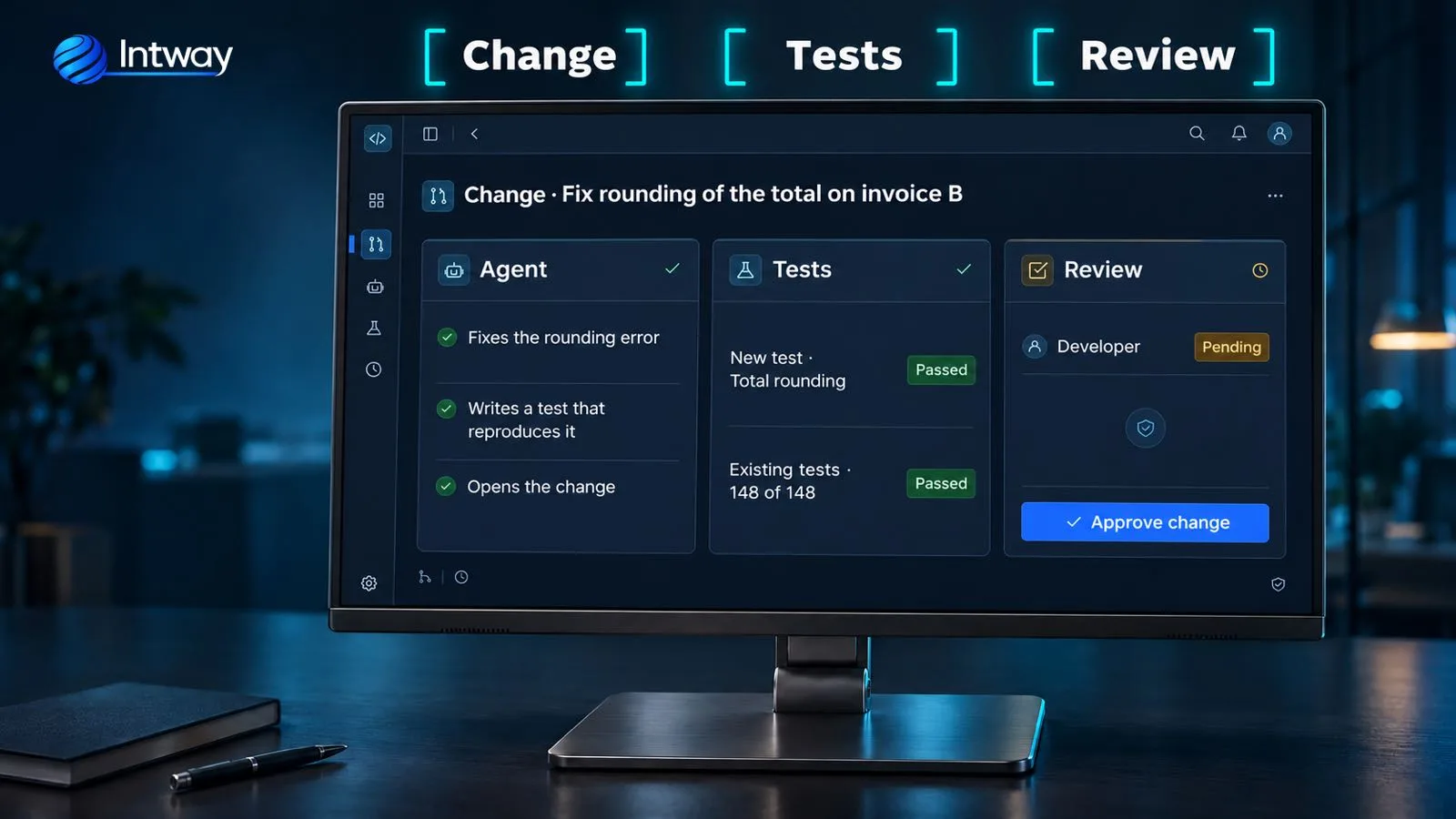
It is the other use Anthropic highlights, because the result is verified by automated tests. A coding agent fixes a rounding error in the invoice total, writes the test that reproduces it and opens the change: the 148 existing tests have to pass and a developer reviews it before it ships.
What is still too early to hand to an agent
- Moving money or doing something irreversible without approval: paying, issuing an invoice, closing a customer account, deleting data. OpenAI calls for human oversight on canceling orders, large refunds and payments until the agent has proven reliable.
- What a workflow already handles: if the steps are always the same, a workflow does it cheaper and the same way every time (we compare them in AI process automation).
- Tasks with no way to check the result: if no one can tell whether it went right, the error surfaces late.
- High volume with thin margins: an agent goes back and forth with the model several times, so it costs more and takes longer; if each case brings in little, it doesn't pay off.
- Reading outside content with broad permissions: an email or attachment can carry hidden instructions the model follows. OWASP calls it indirect prompt injection, a form of prompt injection, which is the first risk (LLM01) on its 2025 list for LLM applications.
Summary: ready today, not yet, not a fit
| Task | Today | With what control |
|---|---|---|
| Answering order and invoice status | Ready today | Read-only, with hand-off to a person |
| Entering orders that arrive by email | Ready today | Stays a draft until someone approves it |
| Questions across ERP and CRM | Ready today | Read-only access |
| Cases with exceptions (refunds, claims) | Ready today | It proposes; a person confirms |
| Fixing code | Ready today | Automated tests and a developer's review |
| Paying, invoicing or closing accounts without approval | Not yet | It proposes; a person approves before it runs |
| Processes with fixed rules | Not a fit | A workflow or the system itself is better |
How to implement an AI agent in a company
- One narrow task with volume, for example order status questions, with a success measure defined before you start.
- Tools with minimum permissions: "look up order" and "create draft", not access to the whole database. OWASP calls giving it too much functionality, permission or autonomy "excessive agency", and recommends enforcing permissions in the target system, not leaving that to the model.
- A person's approval for anything that moves money or can't be undone, and a retry limit: if the agent doesn't understand the case, it hands off.
- A log of every step: what it looked up, what it proposed, who approved it and when.
- Testing with real cases in an isolated environment before opening it up, as Anthropic recommends, and then expanding one task at a time.
How Intway can help
We do AI process automation and artificial intelligence consulting: together we choose which task is worth giving to an agent and which isn't, connect it to your ERP or CRM with just the right permissions, and set up the approvals and the log. We start with a narrow, measurable case and expand when the numbers justify it.