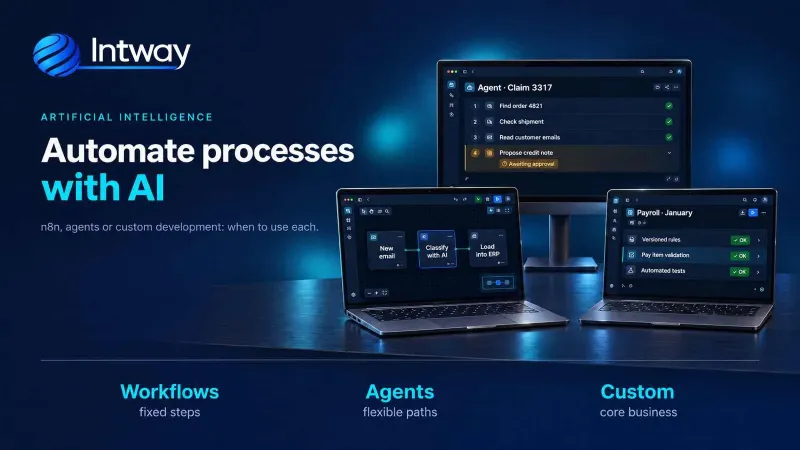
AI process automation: n8n, agents or custom development, when each one fits
What an n8n workflow solves, what an AI agent solves and what custom development solves, when each fits and how to combine them to automate with control.
14/11/2026
Assessment, use case prioritisation, data and privacy, and a measurable pilot to take AI to production in your company.
Artificial intelligence consulting helps you decide where AI adds something measurable to your company, which case to start with and how to take it to production without putting your data at risk. It is the step before implementation: if you already know which process you want to automate, go straight to AI process automation. At Intway we have been building software for more than 25 years, and we apply AI inside systems that are already in production.
If the process isn't defined yet, AI won't organise it: first you need to agree on how the work is done. If the task can be solved with fixed rules, a rule is safer and cheaper than a model. And if an off-the-shelf tool already solves the case, our recommendation will be to use it.
Want to know whether AI makes sense for your company? Tell us which processes take up the most time and we'll tell you where to start, even if the answer is not yet.
The first case isn't the most ambitious one, but the one that can be measured quickly and tolerates mistakes. We choose it with five questions:
| Question | Good sign | Bad sign |
|---|---|---|
| How often does it happen each month? | Hundreds or thousands of cases | A handful a month |
| Is there data to test it? | Real, accessible history | Scattered data or paper |
| What happens if the AI is wrong? | It's corrected without harm | It moves money or affects a person |
| Who reviews the result? | Someone who does the task today | No one assigned |
| How is it measured? | Time, errors or cases resolved | “Better service” |
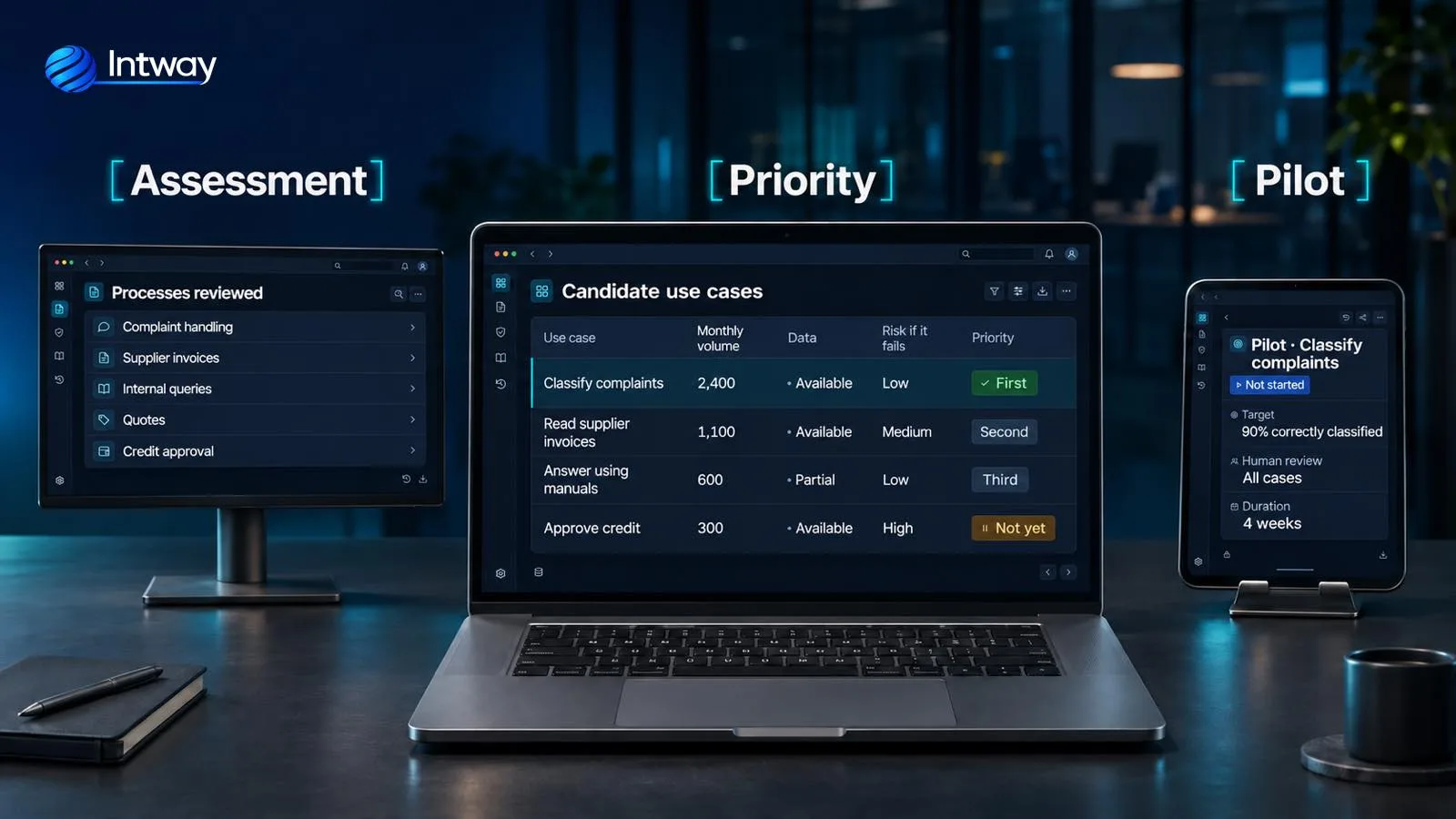
A typical first case is classifying complaints or enquiries: there is volume, there is history and a mistake is fixed by reassigning the case. Approving a loan, on the other hand, moves money and affects a person: it can come later, but not first.
| Off-the-shelf tool | Automation platform | Custom development | |
|---|---|---|---|
| Examples | ChatGPT, Claude or Gemini on a business plan | n8n, Make or Zapier with an AI model | Your own system integrated with your operation |
| Good for | Drafting, summarising and searching; with connectors, querying and acting on other apps | Connecting apps with defined steps | Core processes with rules, permissions and an audit trail |
| Company data | Whatever each person uploads and the sources the company connects and authorises | The data in the connected apps | Whatever is defined, with role-based permissions |
| Where it falls short | When the case needs rules, approvals or integrations its connectors don't cover | When the process grows in rules and exceptions | When the case is standard and a product already exists |
The difference between a workflow, an agent and custom development is explained in AI process automation: n8n, agents or custom development, and how a model is integrated into a product, in generative AI consulting and integration.
Every company's first question is where its data goes. It depends on the vendor and the plan: OpenAI and Anthropic state that, by default, they don't train their models on data from their business plans or their API. Personal accounts have different terms, which is why the team shouldn't put company data into personal tools.
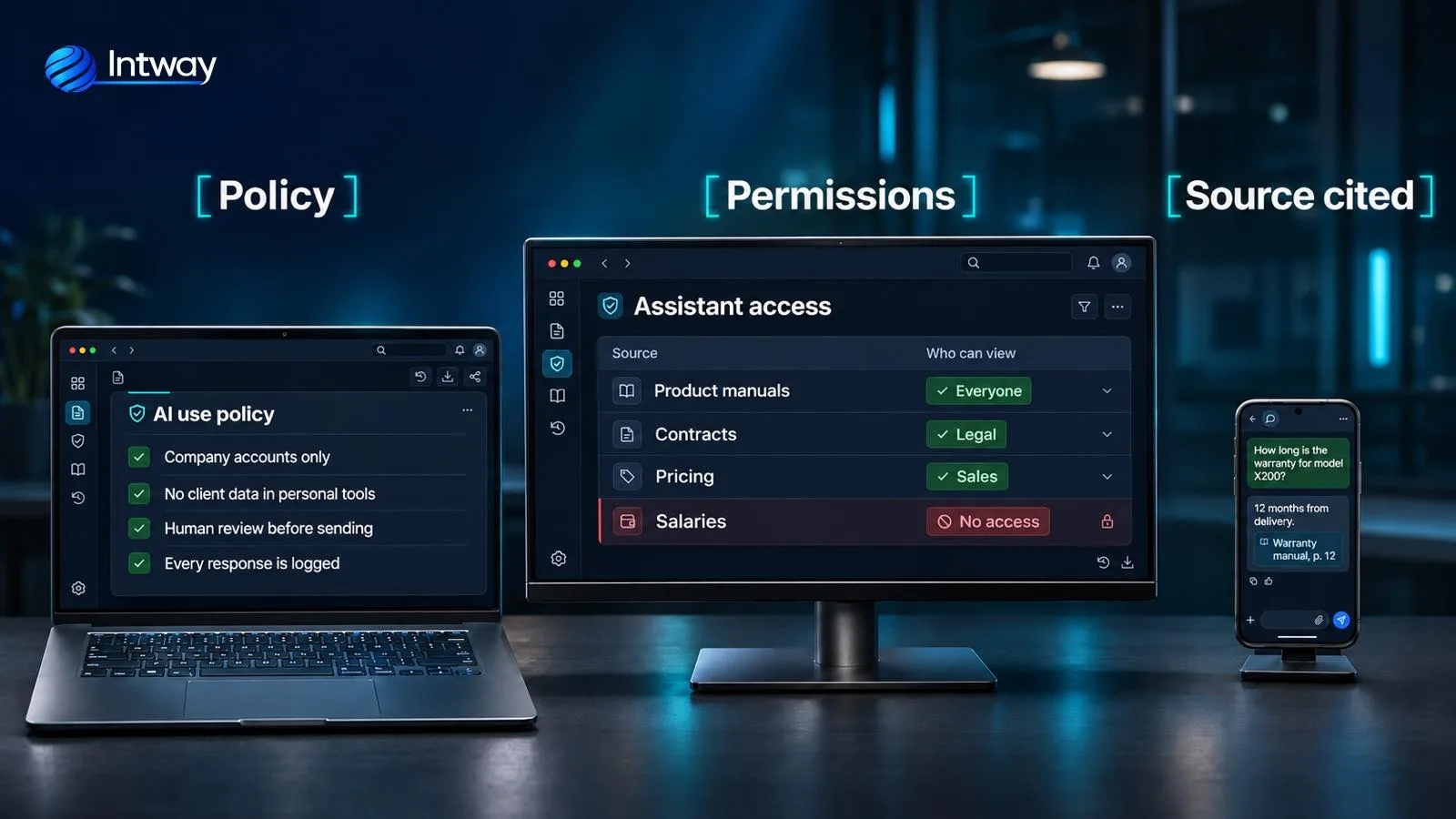
Interviews with the people who do the work, and a review of the systems and the available data. The result is a document with the prioritised cases, which tool fits each one and what needs to be prepared. It is yours, whether you implement it with us or not.
The first case is tested with real data and a target set before it starts: accuracy, time saved or cases resolved. If it doesn't reach the target, it is adjusted or dropped before investing more.
What worked is integrated into the systems you already use, with permissions, logging and human review where it matters. We do that part as AI process automation or as custom software development, depending on the case.
We built a predictive demand model that adjusts stock replenishment before items run out, with a 35% improvement in inventory efficiency, and a face-recognition time and attendance platform used by more than 300 companies. For payroll, on the other hand, we use rules rather than AI: it is part of the same judgement.
It depends on how many processes and areas the assessment covers, how many systems need to be reviewed, whether the pilot has to integrate with an existing system and the level of security the information requires. We quote the assessment after a first conversation, once it is clear which processes and systems it covers, and the pilot and implementation in stages. How we build that number is in how to estimate a software project.
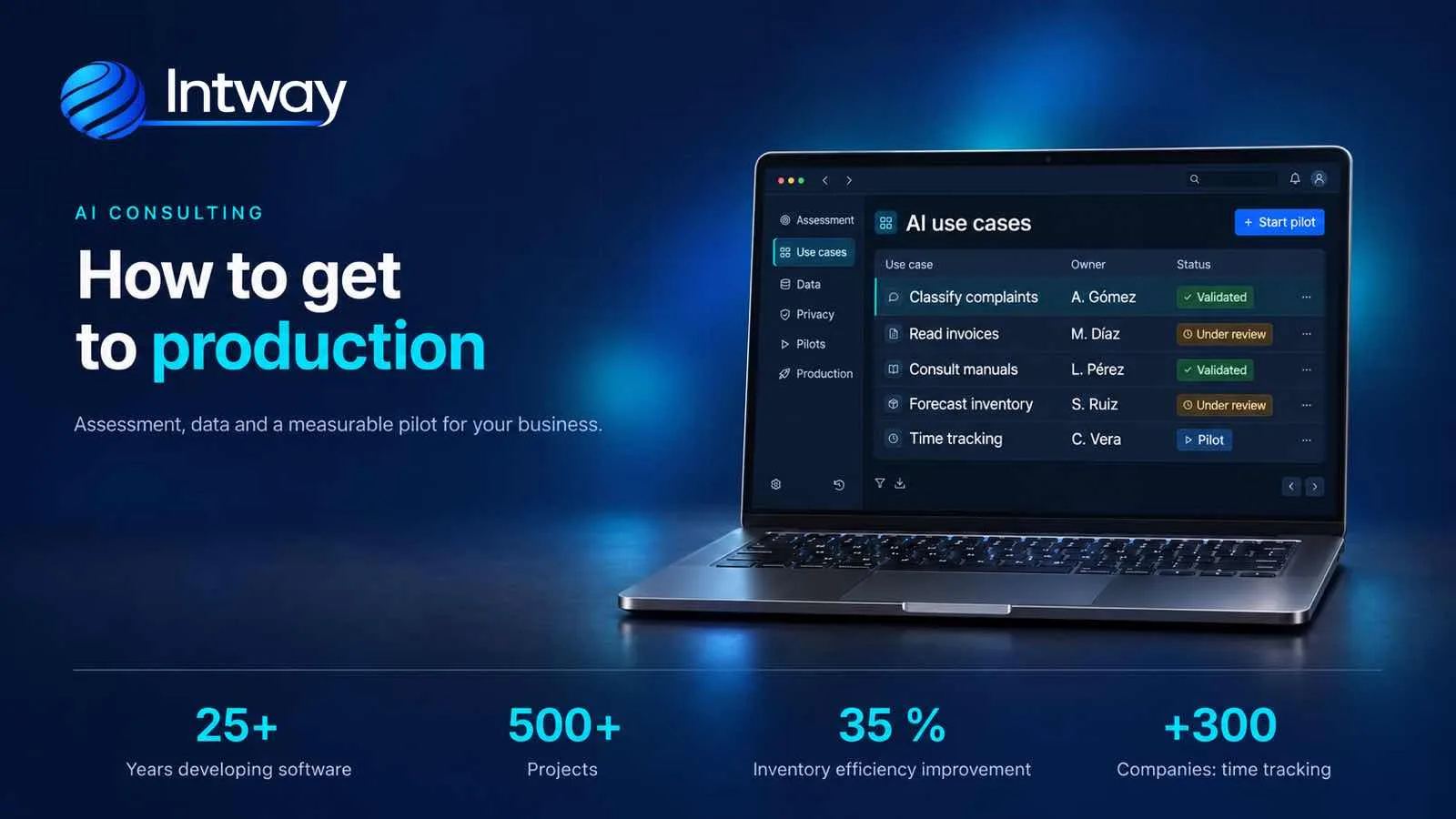
From assessment to the first case in production.
Where the time goes and what data there is.
Ver más →
The first case: measurable and low-risk.
Ver más →
The right tool for each case.
Ver más →
Clear rules before using AI.
Ver más →
A target set before it starts.
Ver más →We don't sell AI: we help you decide where it helps, where it doesn't and how to use it with control.
There is interest in AI, but no concrete case with a target to measure.
Something was tried, worked in a presentation and never reached operations.
The team already uses AI tools and nobody has defined what can be uploaded.
Each vendor offers something different and there is no technical yardstick to choose.
We survey processes, systems and data with the people who do the work.
Cases ranked by value, data and risk, with the right tool for each one.
The first case with real data and a target set before it starts.
Integration into your systems with permissions, logging and human review.
What an n8n workflow solves, what an AI agent solves and what custom development solves, when each fits and how to combine them to automate with control.
An enterprise AI guide: what RAG is, how to apply artificial intelligence to documents, ERP and CRM data, and when AI agents make sense.
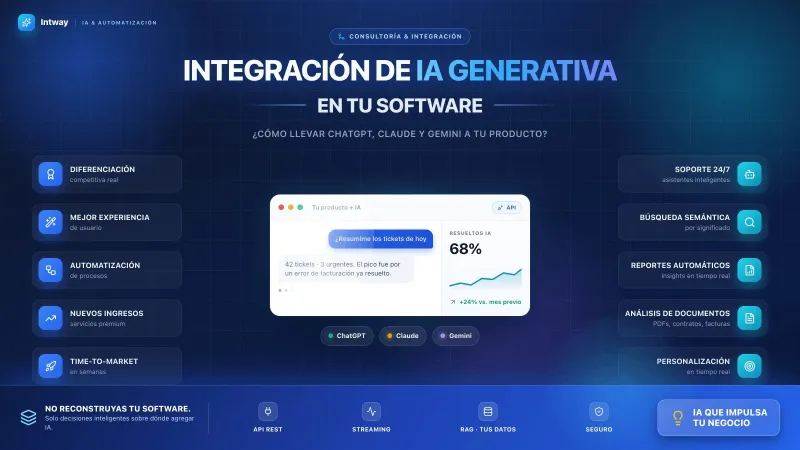
Learn how to integrate generative AI into your existing systems. Complete guide on ChatGPT, Claude, and Gemini to enhance your software and capture new business opportunities.
It analyses your processes and data, defines which cases are worth solving with AI and in what order, picks the right tool for each one, sets the rules for using the data and tests the first case with a measurable pilot.
No. The assessment starts from what you already have and picks a first case that can be tested with that data. If a case needs data that doesn't exist, we say so before investing in it.
It depends on the vendor and the plan. OpenAI and Anthropic state that, by default, they don't train on data from their business plans or their API; personal accounts have different terms. Part of the consulting is defining which tools and accounts are used.
For drafting, summarising and searching, and with its connectors for querying other apps, an off-the-shelf tool is usually enough. When the case needs its own rules, approvals or integrations those connectors don't cover, it is better to integrate it or build. They are often combined.
No. The assessment and the plan are yours. If the recommendation is to use an off-the-shelf tool, we'll say so, and if you want, we can do the implementation.
The assessment is quoted after a first conversation, depending on how many processes and systems it covers. The pilot and implementation are quoted in stages, with what was learned in the assessment.
We'll tell you whether AI makes sense, which case to start with and how to measure it.
Contact us