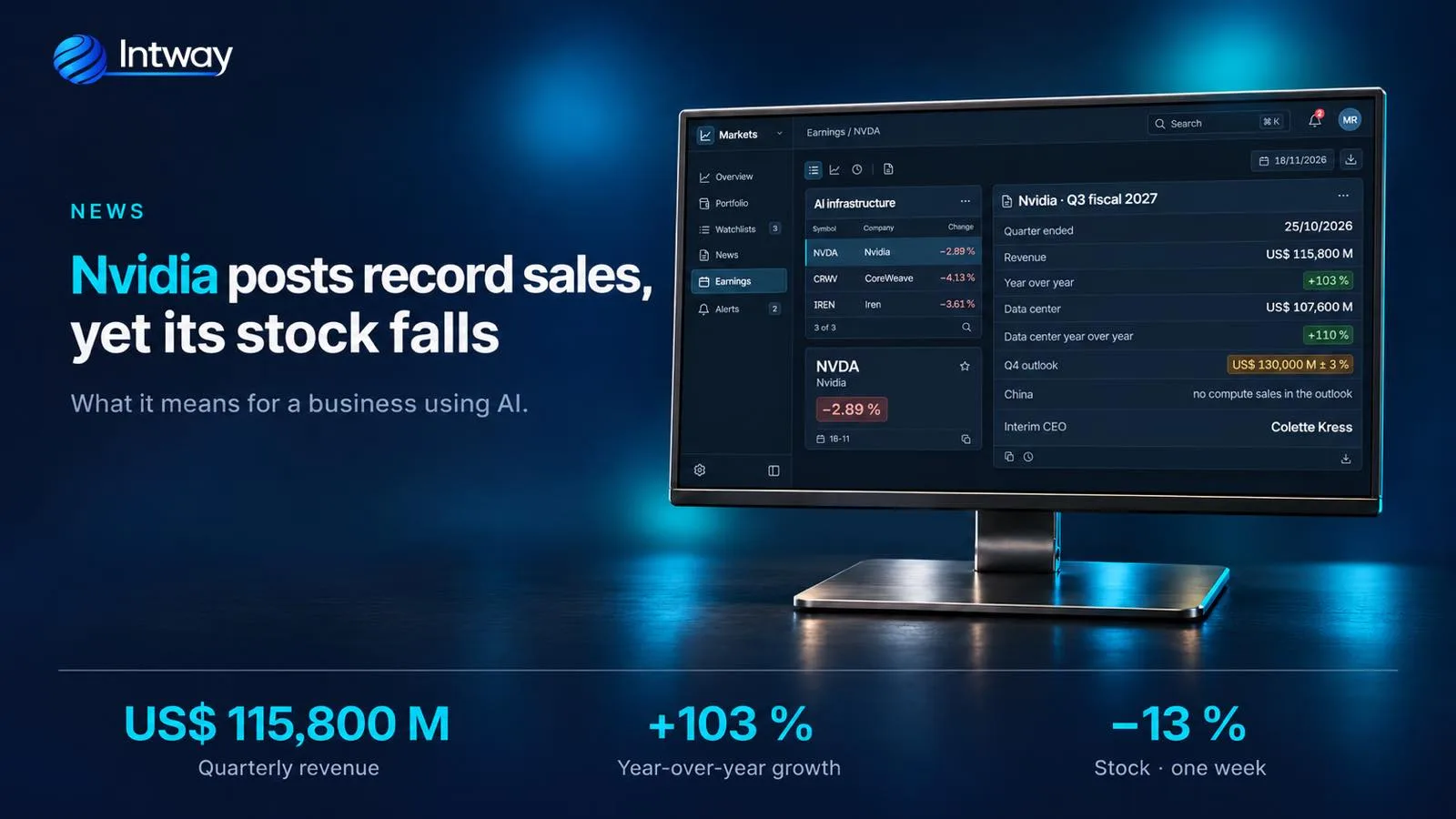
On November 17, 2026, Nvidia, the company that makes most of the chips used to train and run artificial intelligence, reported its fiscal third-quarter results: revenue of US$115.8 billion, up 103% from a year earlier and above what the market expected. Even so, the next day the stock fell 2.89% and was down more than 13% over the past week, according to CNBC. What happened, and what it means for a company that uses AI or wants to.
What happened
- Record revenue. Of the US$115.8 billion in the quarter ended October 25, US$107.6 billion came from data centers: the chips bought by the large clouds and by the companies that offer AI models. That is up 110% from a year earlier.
- A higher outlook. For the next quarter it expects revenue of US$130 billion, plus or minus 3%, without counting data center compute sales in China.
- Results without its founder. Jensen Huang, who had led the company since co-founding it in 1993, stepped down as president, CEO and board member, as Nvidia announced on November 12. The board said it will not reinstate him; chief financial officer Colette Kress is interim CEO while a successor is found.
- China, further away. On Monday the 16th, the day before the results, the US Commerce Department announced it is restricting Chinese companies' remote access to compute in overseas data centers.
Why the stock falls while revenue rises
The market buys expectations, and good numbers were already priced in. What weighs are three questions: who will lead the company, how much is lost with China, and how much longer its large customers will keep buying chips at this pace. The drop pulled down CoreWeave (−4.13%) and Iren (−3.61%), which rent AI compute to other companies. It is not a sign that AI is slowing down, but it is a reminder that the AI a company uses depends on a few chip suppliers and on decisions that company does not control.
What it means for a company that uses AI
Almost all of Nvidia's revenue comes from data centers, and those data centers run the models a company uses every day, for example to sort emails or read invoices. If compute gets scarce or the rules change, AI providers' prices and terms can change too. Four things worth having in place:
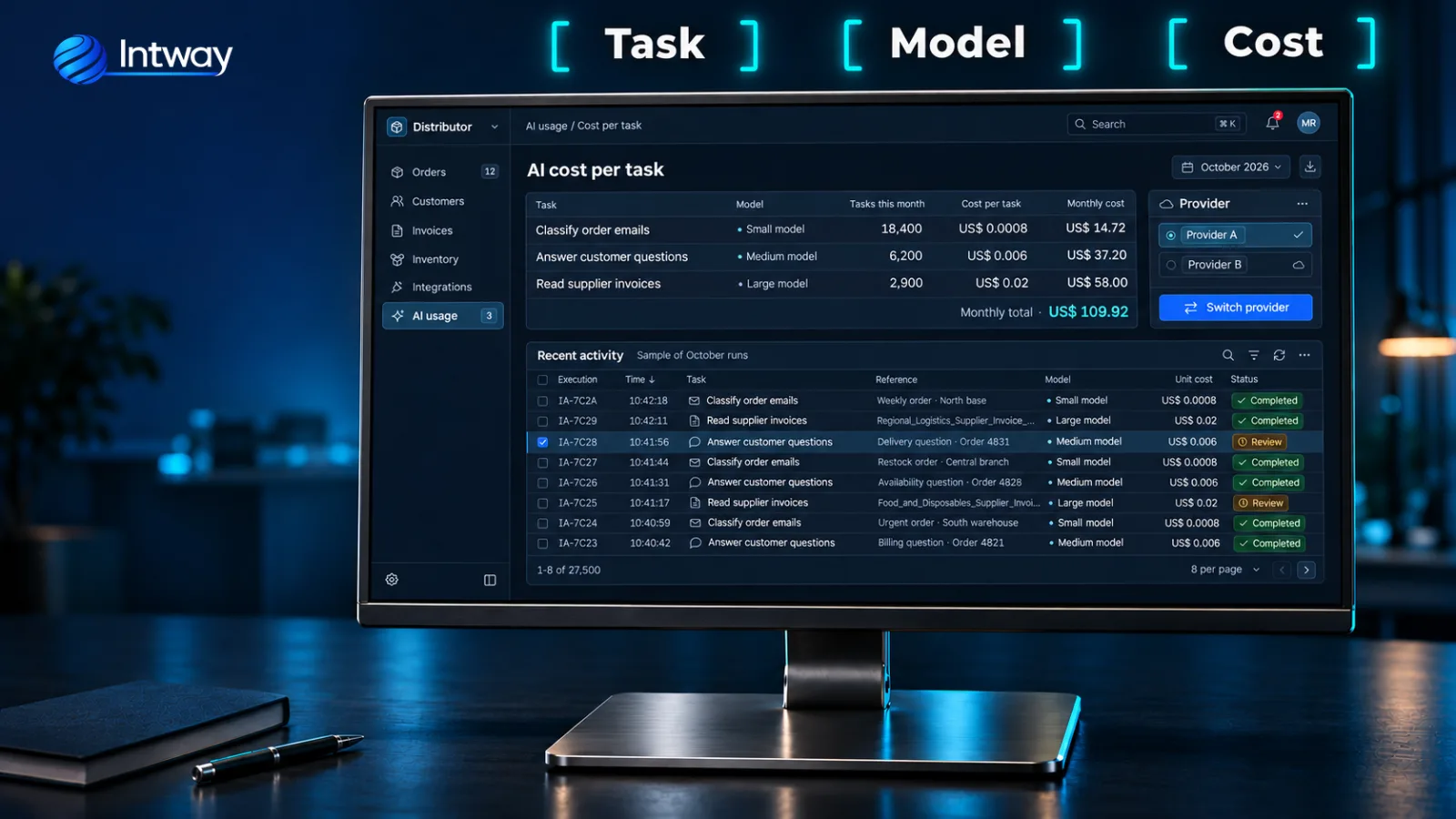
- Measure cost per task, not per month. How much it costs to sort an email, answer a question or read an invoice. That number tells you which automation pays off and which doesn't.
- Use the smallest model that does the job. Keep the large model for what really needs it.
- Don't get locked into one provider. Your own layer between the system and the model lets you switch providers if prices go up or terms change, without rebuilding the system.
- Know where your data runs. The China rule shows that access to compute also depends on government decisions.
A fictional example: a distributor sorts 18,400 order emails a month with a small model at US$0.0008 each (US$14.72), answers 6,200 customer questions with a mid-size model at US$0.006 (US$37.20), and reads 2,900 supplier invoices with a large model at US$0.02 (US$58.00). Monthly total: US$109.92. If a provider raises its price, it knows which task gets more expensive and can move it elsewhere.
What we would do at Intway
If your company is assessing where to use AI, that is what our artificial intelligence consulting looks at: which tasks are worth automating and what each one involves. In AI process automation we explain how the process is kept separate from the model so that switching models doesn't mean rebuilding everything. To see which tasks agents handle today, read AI agents for business.
This article is for information only: it is not investment advice.