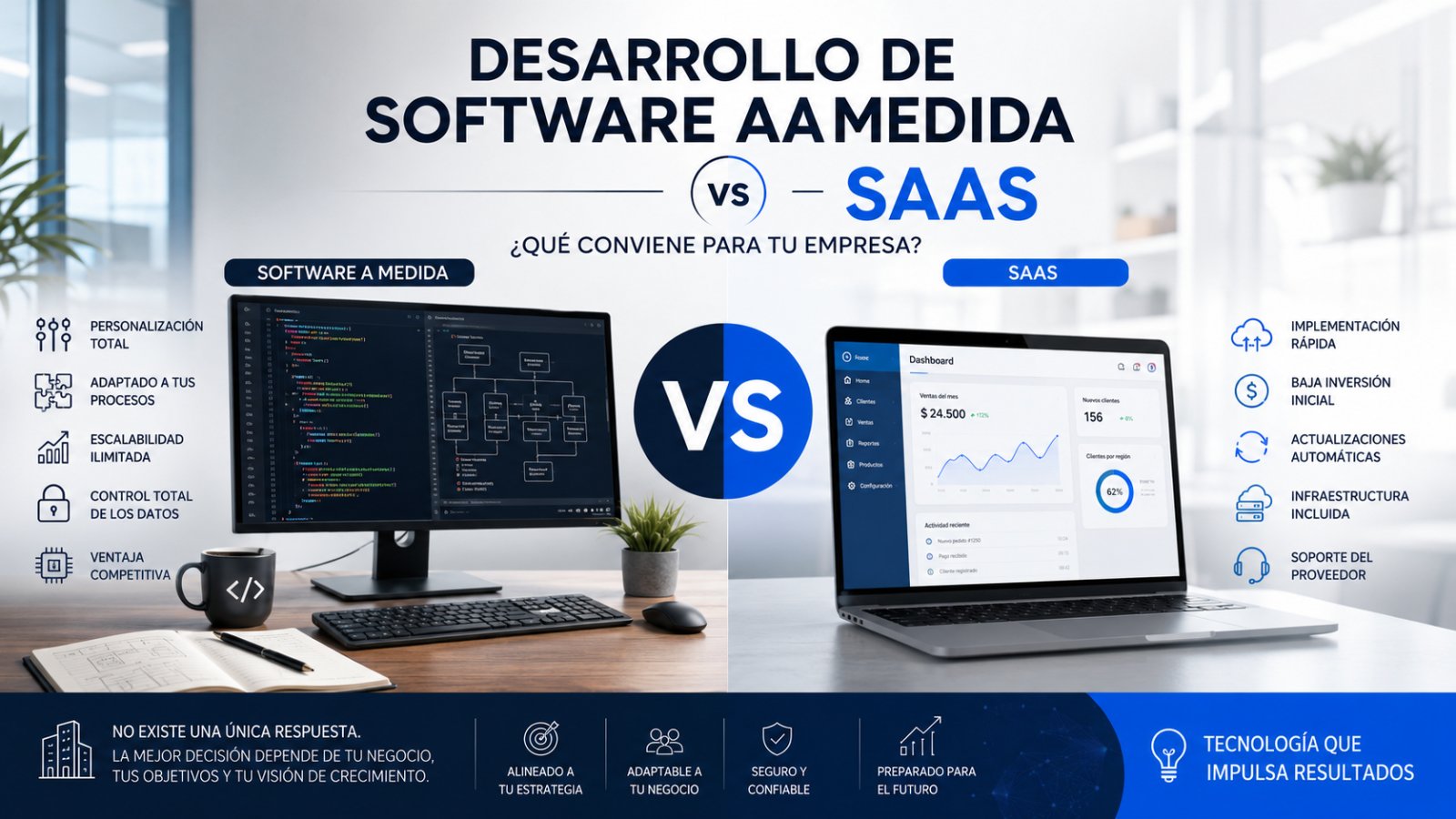
Custom Software Development vs SaaS: Which Is the Best Choice for Your Business?
Learn the differences between SaaS and custom software development to choose the solution that best supports your company's growth.
11/07/2026
We add senior developers to your in-house team, no hiring process, no endless ramp-up.
They are two different ways to add capacity, and confusing them is where most failed engagements start. With team augmentation we place developers inside your team: they report to your tech lead, work your backlog and follow your process. With a software factory you hand us a defined scope and we deliver it working, with our own tech lead and our own process.
One question settles which one you need: who decides what gets built and in what order? If the answer is your team, you need augmentation. If you want to delegate that decision too, you need a factory.
| Situation | Team augmentation | Software factory | Hiring in-house |
|---|---|---|---|
| You have your own tech lead | Ideal | Overlaps | Ideal |
| Scope changes every week | Ideal | Hard to lock down | Ideal |
| Defined project with a deadline | Works | Ideal | Slow and expensive |
| You need to start this month | Yes | Yes | Three to six months |
| The need lasts under a year | Yes | Yes | Not worth it |
| It is your ten-year core business | Complement | Complement | Ideal |
We do not sell augmentation when what you actually need is to hire. If the role is permanent, central and you have time to recruit, the best thing for your company is to have it in-house. Outsourcing the heart of the business forever rarely ends well.
Not sure whether you need two people inside your team or a project delivered turnkey? In a 30-minute call we review your backlog and tell you which model fits, or whether neither does. Get in touch and let us look at it together.
A developer who joins is not productive on day one, and anyone telling you otherwise is selling smoke. What you can do is shorten the curve. We work with an explicit ramp-up: in week one the developer takes small, real tickets rather than reading documentation in a vacuum, and has one person on your side assigned to unblock them.
Architecture and priority decisions stay on your side under augmentation. We bring judgment and we argue our case, but we do not impose: the system is yours and you are the one who will maintain it. Under the factory model it is the reverse, and there we take full technical responsibility for the deliverable.
You interview every profile before they join. If someone does not work out in your context, technically or with the team, we replace them with no argument and no replacement fee. That is the only guarantee that matters in this business.
It is not just the hourly rate. What moves the real number of an external team is this:
We build the proposal after looking at your backlog, not before. Tell us what you need to solve and we will come back with a team composition and a number.
Always. We present profiles with their real experience and you interview them as if they were joining your payroll. If none convince you, we keep looking.
We replace them. We do not bill the replacement's onboarding time and we do not tie you to a minimum tenure per person.
The team is based in Argentina and works hours that overlap with the Americas and the European morning. Real time-zone overlap is what makes this work: it is not overnight offshore.
You do, from the first commit, in your repositories and under your accounts. We keep no copies and never reuse your code with other clients.
Team augmentation rarely comes alone. If what you need is a system built from scratch, we do it as custom software development. If the work is connecting platforms, it belongs in e-commerce and marketplace integrations. And if your backlog is stuck behind an old system nobody wants to touch, read how we handle progressive modernization before adding people.
Across 25 years and more than 500 projects we learned that an external team does not replace your own judgment: it multiplies it when it exists, and exposes its absence when it does not. That is why the first conversation is always about your backlog, never about our rates.
Scale your development capacity — no hiring process, no endless ramp-up.
The bottlenecks that slow down in-house development teams.
We add senior developers to your current team, without going through a months-long hiring process.
You scale the team for a big project or a specific migration, without committing to permanent headcount.
We add AI, cloud, or integration specialists only for as long as the project needs them.
We identify the profile, seniority, and stack your team needs to cover the current gap.
We put together a proposal of developers with the specific experience your project requires.
The team joins your tools, methodology, and rituals, with no friction for your in-house staff.
We adjust capacity up or down as project demand evolves.
It depends on your needs: we bill hourly/monthly when scope is variable, or as a fixed project when the scope is defined upfront.
Yes. The team works within your existing toolset and methodology, not their own.
Once the profile is defined, the team is usually operational within 1 to 2 weeks.
The team operates as a unit, with continuity, backups for absences, and accountability for delivery, something an individual freelancer usually can't guarantee.
We work with documented processes and agile methodologies: version control, peer code review, testing on every release, and change control, aligned with the quality management best practices of the ISO 9001 standard. This gives full project traceability and predictable deliveries.
Tell us what you need to cover, and we'll propose the right team to do it, no runaround.
Contact us