Custom software for healthcare organizations
We build software for clinics, hospitals, labs and payers, integrating clinical and administrative processes on top of your existing infrastructure.
Why build custom software for healthcare
Healthcare organizations — clinics, hospitals, laboratories, diagnostic centers, payers and insurers — run on sensitive data, regulated processes and administrative workflows that off-the-shelf products rarely cover end to end. Every institution schedules, bills, authorizes procedures and documents clinical progress in its own way. When software does not follow those workflows, teams compensate with parallel spreadsheets, duplicate data entry and manual controls that consume hours and introduce errors with a direct impact on care and billing.
Custom development reverses that equation: the system is designed around the organization's actual processes, integrates with existing platforms and evolves with the operation. At Intway we have delivered more than 500 software projects across different industries over the last 25 years, and our approach is the same in all of them: understand the operational problem before proposing technology.
When custom development makes sense — and when it does not
Not always. If a market product covers most of the need and the organization can adapt to the rest, an off-the-shelf solution is usually the reasonable choice. Custom development pays off when the process is part of the institution's differentiation, when integration between clinical and administrative systems is critical, when volume or complexity exceed what standard products handle, or when accumulated licensing costs outweigh building your own asset in the medium term. Before proposing a solution we analyze your processes, your existing systems and the cost of each alternative: in some cases we recommend building custom software; in others, integrating or adapting an existing solution.
Healthcare software solutions
Electronic health records and clinical management
We build Electronic Health Records (EHR) tailored to each specialty's workflows: role-based permissions, full traceability of every record and integration with laboratory, imaging and prescriptions. The goal is to simplify clinical documentation, reduce administrative workload and keep clinical information available, auditable and protected.
Scheduling, patient portal and telehealth
Centralized scheduling for one or multiple locations, automatic confirmations and reminders, patient self-service on web or mobile, and telehealth modules for video consultations. Everything connects with admissions and billing so the workflow never breaks.
Administration and payer billing
Claims and settlements with payers and insurers, authorization management, denial control and reconciliation. This is one of the areas where automation delivers the most value: fewer rejections, less rework and real visibility over collections.
Interoperability and integrations
Integration across HIS, LIS, RIS/PACS and payer platforms using standards such as HL7 and FHIR, or custom APIs — including integration with medical equipment: DICOM imaging, laboratory analyzers and other medical devices. We also integrate existing ERP and administrative systems (SAP and Oracle, among others) and modernize legacy systems through gradual migrations, without stopping the operation. We regularly publish on this approach in architecture and integrations.
Technologies we frequently work with
We choose the technology based on the problem, not the other way around. We typically work with React and React Native on the frontend; Node.js, Java and .NET on the backend; PostgreSQL and SQL Server as databases; and Docker, Kubernetes and clouds such as AWS, Azure or Google Cloud for infrastructure. In healthcare, interoperability standards such as HL7, FHIR and DICOM are part of the toolkit as well.
Security and regulatory compliance
Health data is sensitive data: depending on the country and the type of organization, regulatory frameworks such as HIPAA or GDPR may apply, in addition to local data protection laws. That is why security is defined at design time, not at the end: encryption in transit and at rest, role-based access control, audit logging of every operation, and on-premise or cloud deployment according to each institution's policy.
Applied AI in healthcare, without empty promises
We do not propose AI because it is fashionable: we implement cases with a measurable operational benefit. In healthcare, that benefit is usually found in back-office and document-heavy processes: classification and data extraction from clinical and administrative documentation, assistance with procedure coding, authorization automation and semantic search over internal protocols. Always with human review, with metrics defined before scaling, and never replacing clinical judgment. You can read about our approach in applied artificial intelligence.
Common mistakes in healthcare software projects
- Digitizing a broken process without redesigning it first: software amplifies whatever it finds, including the disorder.
- Leaving interoperability for the end, when it should shape the architecture from day one.
- Not involving clinical and administrative staff in the design: systems nobody uses transform nothing.
- Treating security and compliance as a final formality instead of a design requirement.
- Attempting a single all-at-once rollout (big bang) instead of a staged plan with verifiable results.
Why choose Intway?
- Over 25 years building enterprise software.
- More than 500 projects delivered across different industries.
- Senior teams with experience in mission-critical projects.
- Open, integrable and scalable architectures for multi-site organizations.
- 100% custom development, with incremental deliveries from the start of the project.
- Third-party platform integration and modernization of existing systems.
- Support from discovery to long-term evolution.
If your organization is evaluating a project like this, we publish guides and analysis on how we approach it in Insights.

Detalles
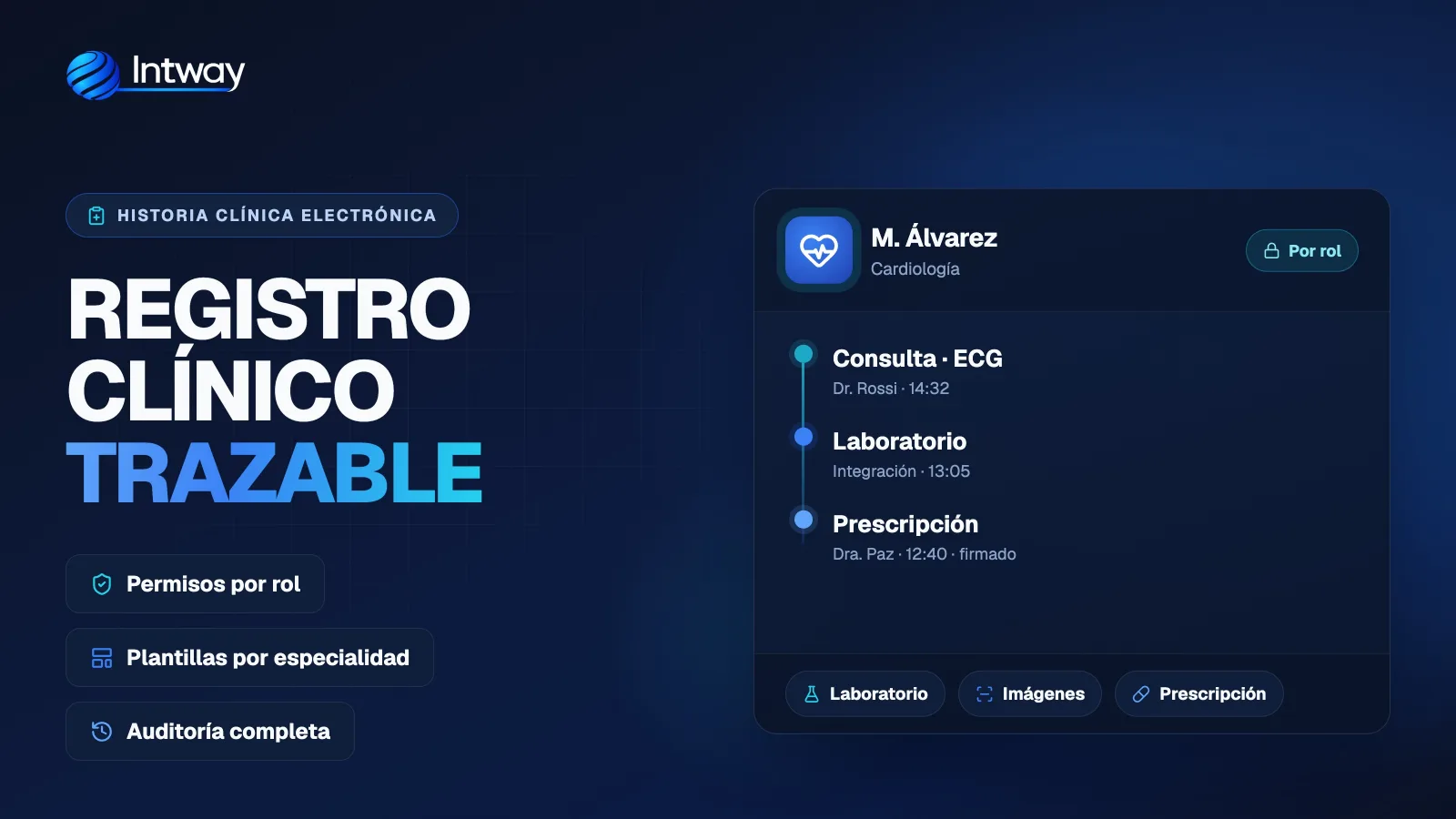
Electronic health records and clinical management
A unified, traceable clinical record designed around each specialty's real workflows.
Ver más →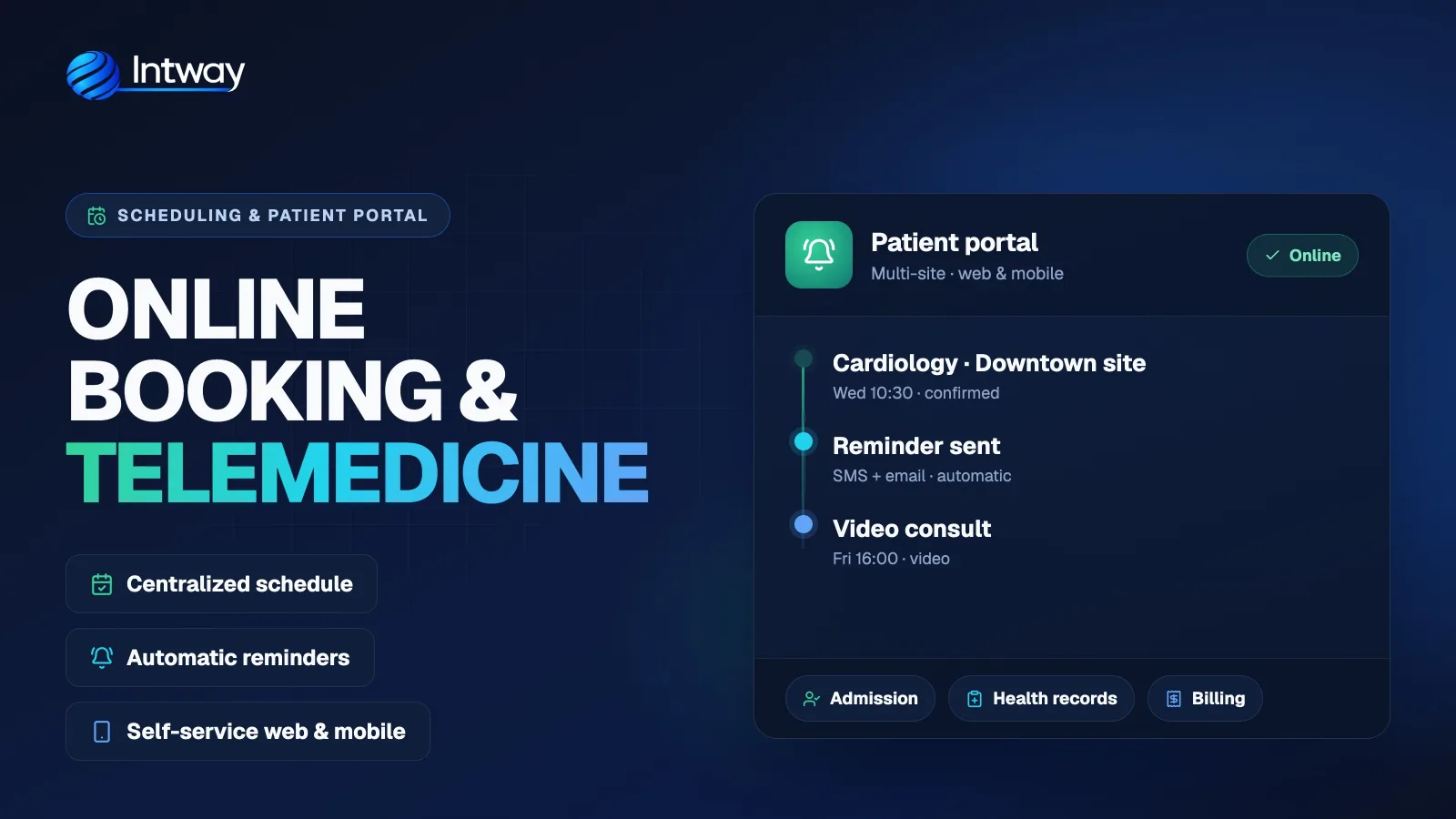
Scheduling, patient portal and telehealth
Centralized scheduling, automatic reminders and patient self-service on web and mobile.
Ver más →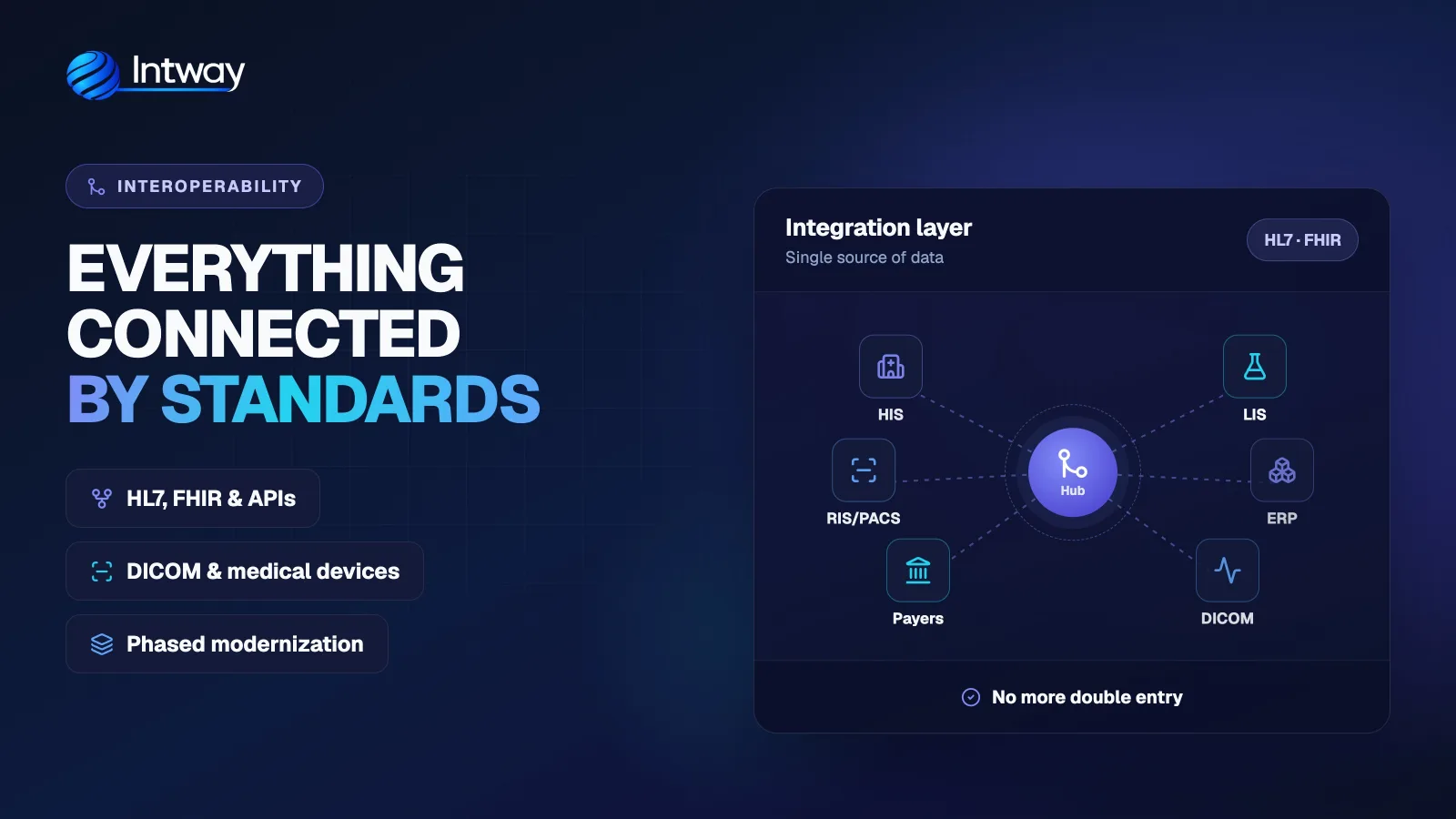
Interoperability and integrations
Clinical systems, ERP platforms and medical equipment connected through HL7, FHIR and APIs.
Ver más →What we solve in healthcare
Concrete operational problems for clinics, hospitals, laboratories, payers and insurers.
Electronic Health Records (EHR)
A unified, traceable and auditable clinical record, tailored to each specialty's workflows.
HL7 and FHIR interoperability
Integration across HIS, LIS, RIS/PACS, ERP and payer platforms to eliminate duplicate data entry.
Sensitive data protection
Role-based access control, encryption and full audit trails, aligned with data protection regulations.
How we work
Discovery
We study the clinical and administrative processes together with the people who run them, and map the existing systems.
Solution design
We define the architecture, the integrations and a staged implementation plan, with clear scope and priorities.
Iterative development
Incremental deliveries validated with real users, and continuous quality assurance throughout the project.
Deployment and evolution
Go-live on-premise or in the cloud, team training and continuous improvement of the system.
Do you build custom electronic health records?
Yes. We design the EHR around each specialty's workflows, with role-based permissions, full traceability and integration with laboratory, imaging and prescriptions. We can also integrate it with systems already in use at your institution.
Can you integrate with third-party software?
Yes. We work with standards such as HL7, FHIR and DICOM and with custom APIs to connect HIS, LIS, RIS/PACS, ERP and payer platforms. When third-party software does not expose an interface, we evaluate the technical alternative together with the vendor, and where legacy systems exist we propose a gradual modernization that preserves operational continuity.
Can you work on an existing system?
Yes, it is a common scenario. We can take over the evolution of a system built by a third party, add new modules on top of the current platform, or plan a staged modernization. In every case the principle is the same: move forward without disrupting day-to-day operations.
How long does a project take?
It depends on the scope. That is why we work with incremental deliveries: we define a first version that goes into production and delivers value, and from there the system evolves in planned stages. Timelines are estimated after discovery, with a concrete scope on the table.
How do you protect patient data?
Health data is sensitive data and we treat it accordingly: encryption in transit and at rest, role-based access control, audit logging of every operation, and on-premise or cloud deployment according to the institution's policy and the applicable regulations.
Let's talk about your project
Tell us the operational or clinical problem you need to solve and we will propose a concrete approach.
Contact us