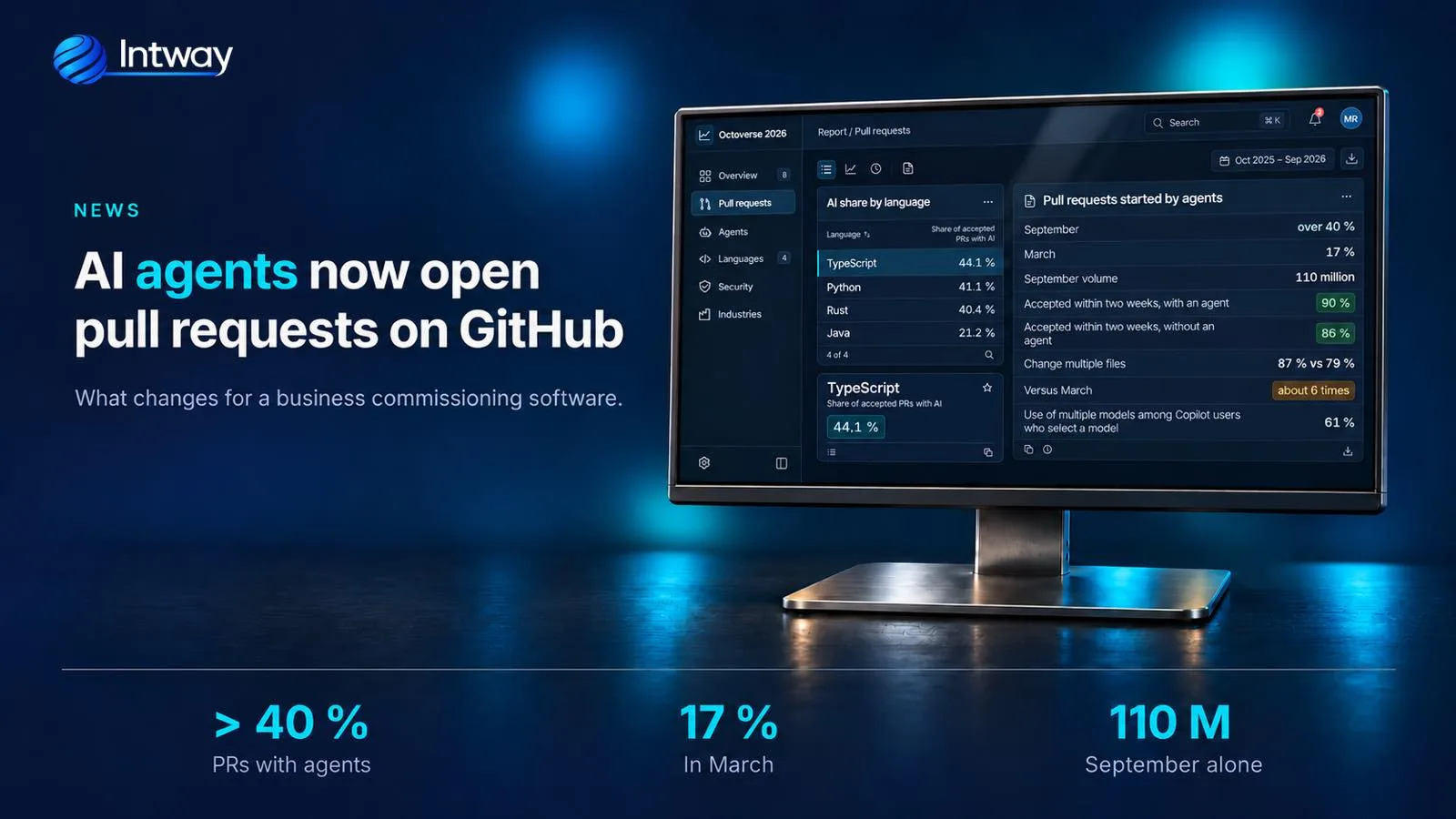
On October 28, 2026, GitHub, the platform where more than 225 million developers store and share code, published Octoverse 2026, its annual report. The figure that stands out: in September, more than 40% of pull requests started with a first draft written by an AI agent. In March it was 17%. A pull request is the proposed code change a team reviews before adding it to the system. What happened, and what it means for a company that commissions or maintains software.
What happened
- Six times more in six months. In September alone, 110 million pull requests started with an agent, about six times March's volume. GitHub notes this is a floor: it does not detect every use of agents.
- More code than ever. In the twelve months to September 30 there were 17.9 billion code pushes, more than 2024 and 2025 combined, and 1.3 billion pull requests were merged: 3.5 million a day.
- Merged as often as the rest. In February, 83% of agent-involved pull requests merged within two weeks, versus about 86% of the rest. By September it was 90%, while the rest held at 86%.
- More than one model. In September, 61% of GitHub Copilot users who pick the model themselves used more than one.
- More checks. Use of AI-assisted code review and of GitHub Advanced Security, its security suite, both grew more than 90% in a year. The check that blocks keys and passwords written into code ran 5.8 billion scans, nearly four times 2025's pace.
Why it matters
With an agent, the first draft of a change can come much faster; what stays with the team is deciding what to build and reviewing what comes back. The report says as much: someone still has to decide whether it works, whether it belongs and whether it is good. And there is more to review: 87% of agent-started pull requests touch several files, versus 79% of the rest.
The shift is uneven. Of the pull requests merged in each language, those with AI involvement are 44.1% in TypeScript, 41.1% in Python and 40.4% in Rust, versus 21.2% in Java. And among public repositories, about 9% of construction ones received at least one pull request opened by an agent, the highest share of any sector, while in health care, mining and agriculture it was under 3%.
What it means for a company that commissions software
An agent that writes faster is no help if nobody controls what gets in. Five things worth asking of whoever builds your system:
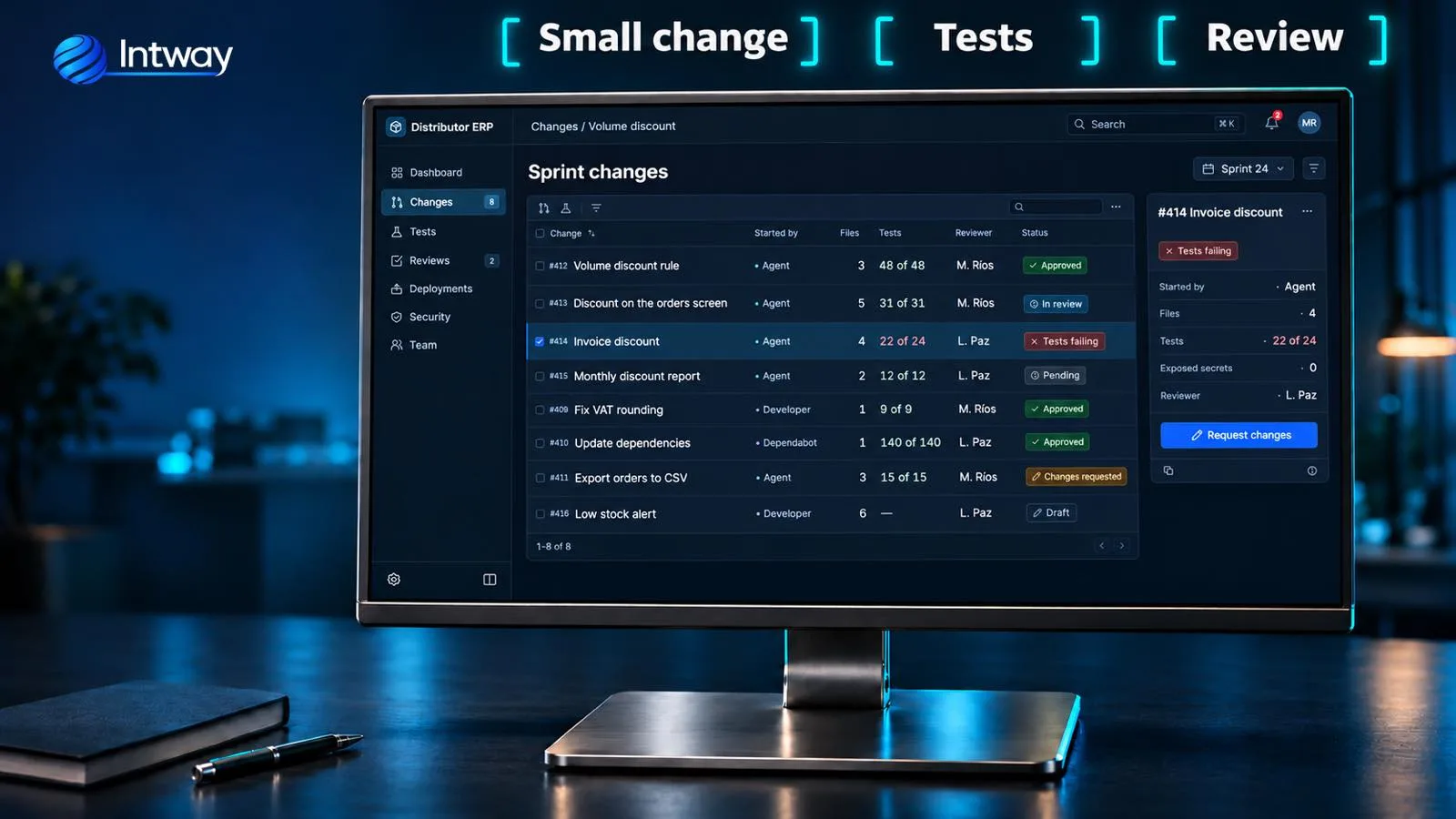
- Small changes. A large request is split into changes that are reviewed one at a time. GitHub added a feature in July to chain them, and by September more than 264,000 developers were using it.
- Automated tests on every change. They stop whatever breaks something that already worked, whoever wrote it.
- A person who reviews and answers for it. The agent proposes; a developer approves or asks for changes.
- No keys in the code, and the agent with just the permissions it needs.
- Measure deliveries and errors, not lines of code written.
A fictional example: a distributor asks for a volume discount in its management system. The request is split into four changes: the discount rule, the orders screen, the invoice and a monthly report. An agent writes the first draft of each; the tests run on their own and, if they fail, the change does not move forward; a developer reviews each one and approves it or asks for fixes.
What we would do at Intway
In our software factory and team augmentation work we use version control, peer code review, testing on every delivery and change control: what it takes for what an agent writes to reach the system reviewed. If you are about to commission a system, custom software development explains how we work end to end. And to see which of your company's tasks agents can handle today, read AI agents for business.