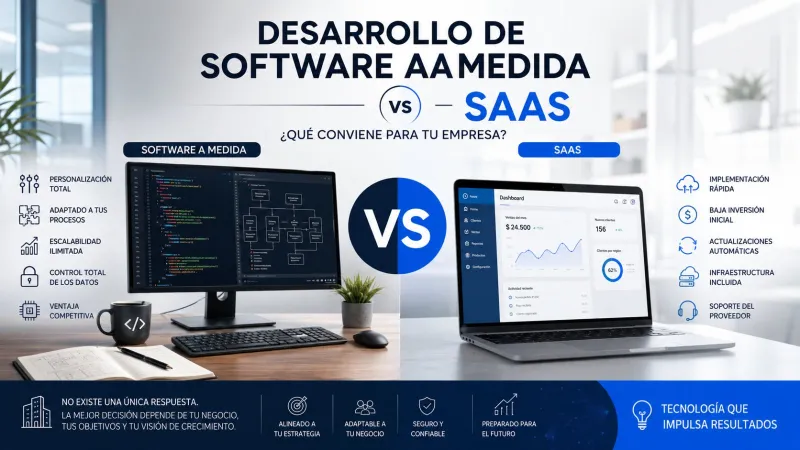
Custom Software Development vs SaaS: Which Is the Best Choice for Your Business?
Learn the differences between SaaS and custom software development to choose the solution that best supports your company's growth.
11/07/2026
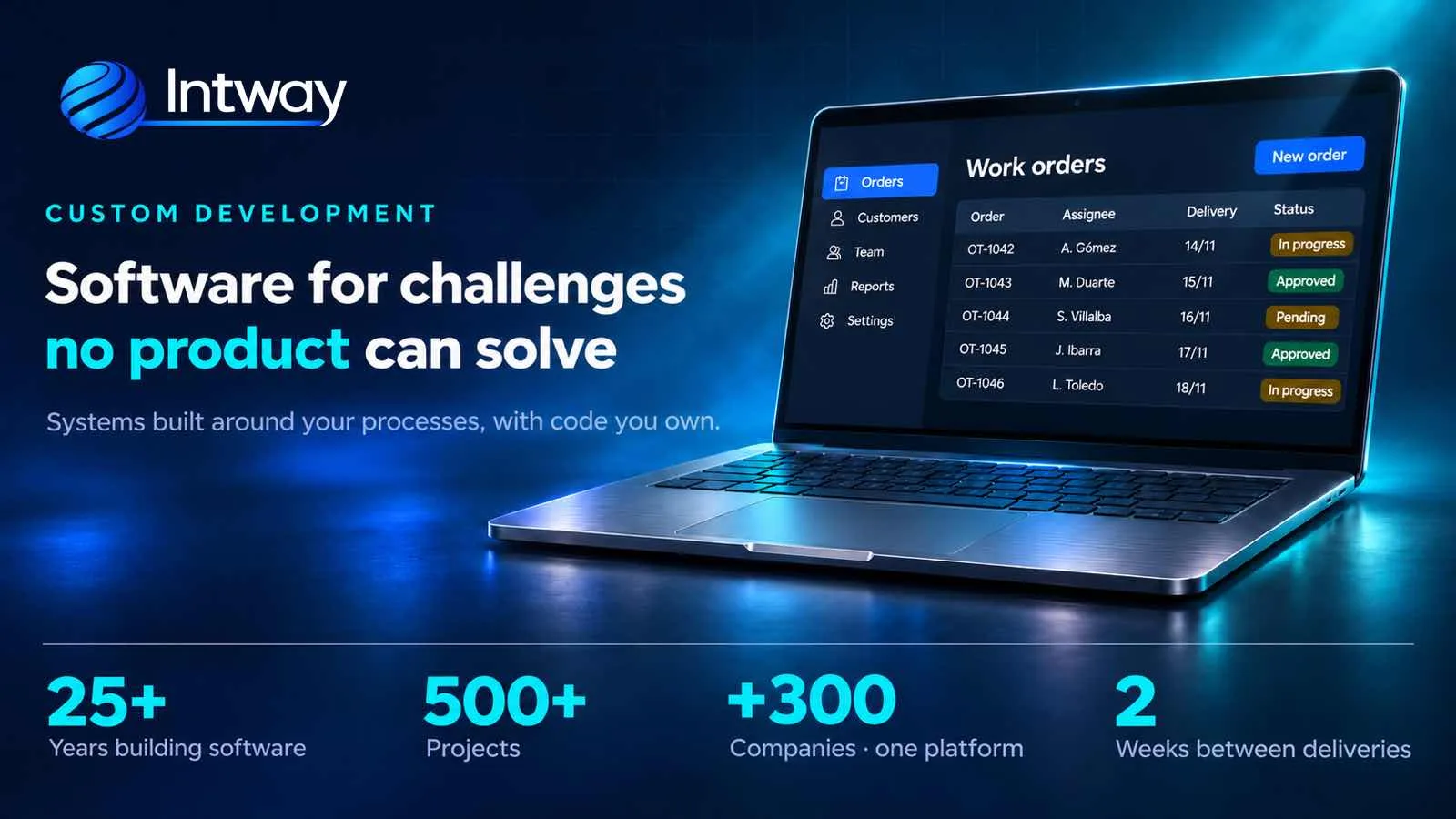
Management systems, integrations, modernisation and apps built around your processes, with releases every two weeks and the code in your name.
Custom software development means building the system your company needs instead of adapting the company to a product. At Intway we have been doing it for more than 25 years: management systems, integrations between systems, modernisation of old systems, apps, portals and artificial intelligence applied to real processes. This page explains what our services include, when building makes sense, how we work and what drives the cost. If you are a small or mid-sized business moving off spreadsheets, also see custom software for small and medium businesses.
It is a system designed around your processes, your rules and your data, with the code and the database in your company's name. It isn't a generic product customised until it looks like your operation, or a two-year project you only get to see at the end. And it is rarely a fresh start: often the job is to connect what already works, replace the part that got old or add a new channel without touching the core system.
If the process is standard, such as accounting, payroll or plain invoicing, a well-integrated product almost always wins; we explain it in custom software vs SaaS. And if you already have a development team and what you lack is people, what you need is the software factory and team augmentation.
Not sure whether to build, integrate or buy? Tell us what you want to solve and we'll tell you which path makes sense, even if it isn't building.
| Need | Custom development | Off-the-shelf SaaS or ERP | In-house team |
|---|---|---|---|
| A process specific to the business | Designed around the process | You adapt to the product | Yes, if the team has the experience |
| Start fast | First release in weeks | Fast if the process fits | Months to build the team |
| Integrate with what you have | Defined in the design | Depends on the vendor's API | Yes |
| Changes when the business changes | On your priorities | On the vendor's | On your priorities |
| Ownership of code and data | Yours | The vendor's | Yours |
| Cost over time | Per stage, no per-user licences | Per-user licences | Fixed salaries even without a project |
Before giving a number we look at how the process works today: who enters what, in which system, what gets redone by hand and where information gets lost. That tells us what to build first and what is better left as it is.
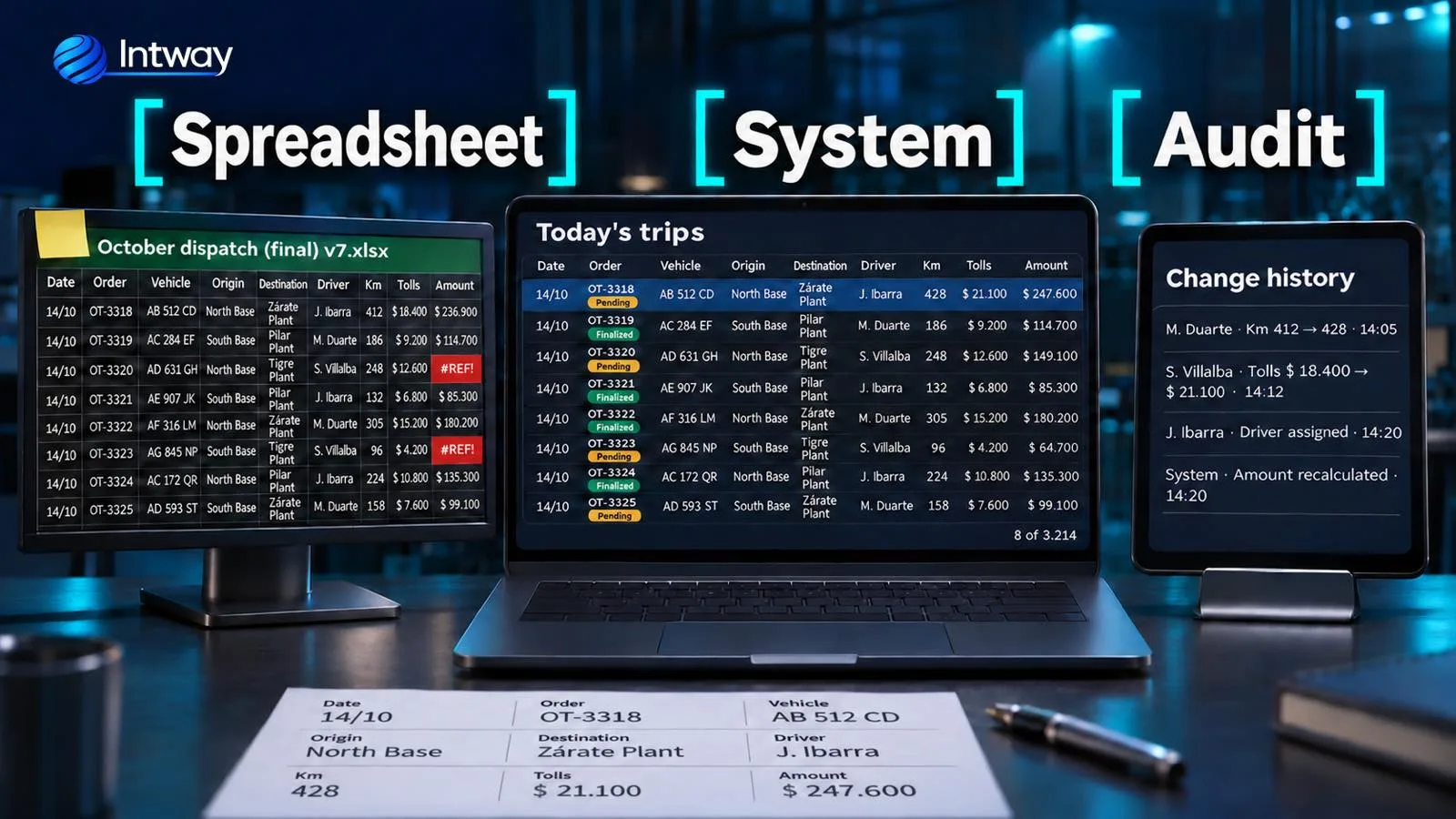
The first release solves a concrete problem and is actually used; it isn't a mock-up. Then we add the rest piece by piece, with releases every two weeks that you can see and try. That is how we replaced a traffic spreadsheet that decided how much to pay for each trip: it became a system with its formulas and a record of who changed each value.
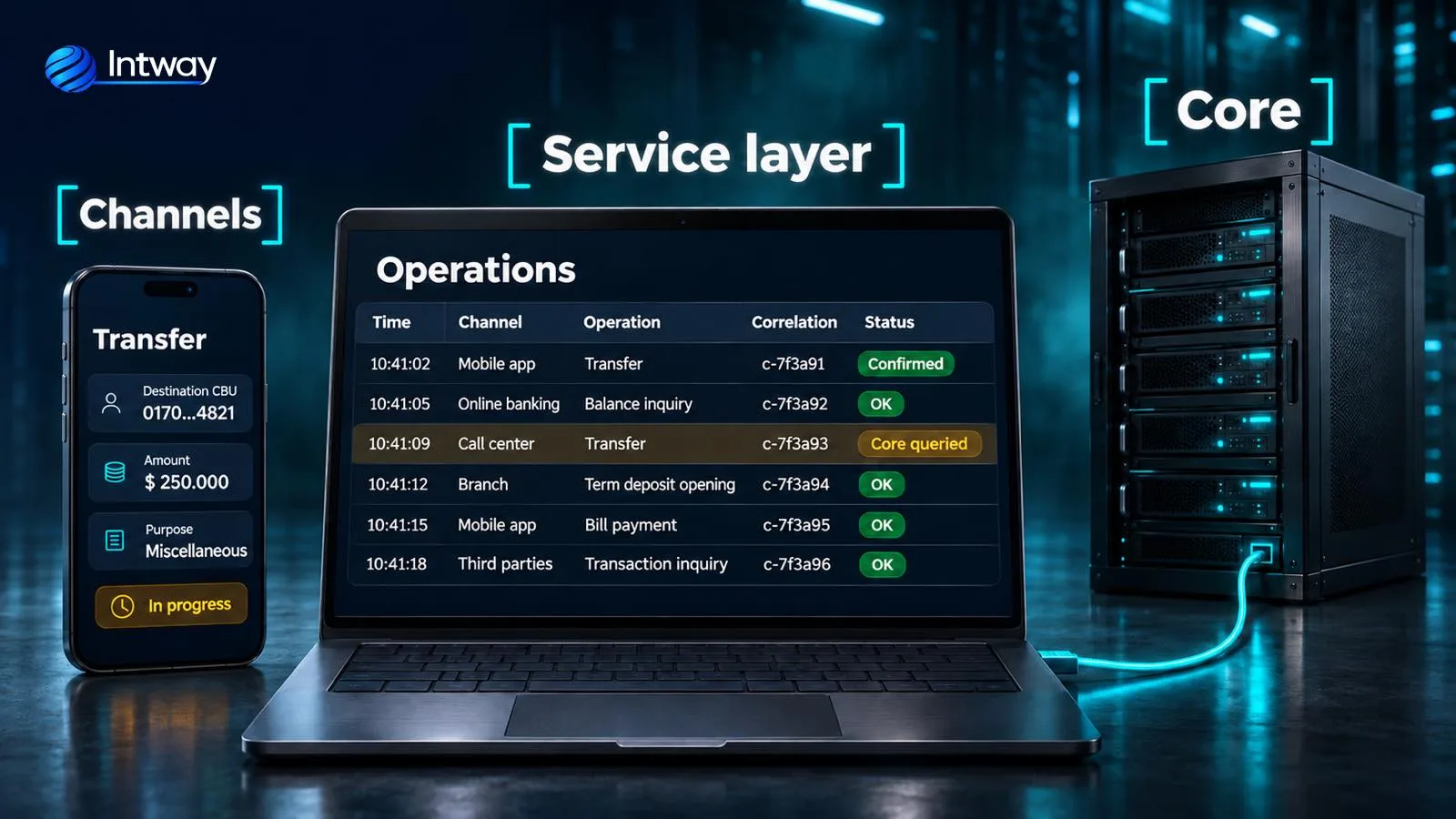
Almost no project starts on a blank page. When there is a core system that works, such as a banking core or an ERP, we build a service layer that connects it to the new channels without modifying it, and we migrate in parts, with both systems running in parallel until the new one proves it gives the same results.
Automated tests on every release, role-based permissions, a record of who did what and backups from day one. In systems that run payroll, collect or pay, every result has to be explainable later.
The repository, the database and the cloud accounts stay in your company's name, with the documentation another team needs to carry on. We work with Node.js, NestJS, Next.js, React Native, Go and PostgreSQL, on AWS or on your own servers.
| Starting point | What we built | Result |
|---|---|---|
| Dispatch for 18 trucks and more than 3,200 trips a month in an Excel file with fragile formulas | A dispatch system with the rates, the settlement and an audit trail of every change | One version of the data, with every amount calculated and traceable. See the case |
| A Visual Basic payroll engine that only ran on Internet Explorer | A multi-country cloud payroll platform, migrated in parts | No Internet Explorer, every item traceable and no missed pay runs. See the case |
| A financial institution where every new channel was integrated with the core from scratch | A service layer between the core and six channels | Core untouched and no duplicated operations after a cut-off. See the case |
| A field service company with 34 technicians and paper work orders | An app that works with no signal and a dispatch panel | Unsigned orders from 31% to 2%. See the case |
| Companies with no reliable record of working hours | Face-recognition time clock with payroll from the same punch | More than 300 companies and more than 10,000 users. See the case |
It depends on concrete things, and it helps to have them clear before asking for a quote:
We quote the first stage with a fixed scope and price after discovery, and the rest stage by stage. How we build that number is in how to estimate a software project. For a concrete proposal, get in touch.
Dispatch, route sheets, proof of delivery, customer rates and driver settlement, with each trip connected to invoicing so nobody re-enters what happened on the road. See software for logistics and transportation and the guide to transportation management software.
Work orders, each unit's history, spare parts, customer signature and technician dispatch, with an app that works even when the equipment is in a basement. See software for maintenance and field service.
Medical records, appointments, billing of services and medication control, with role-based permissions and protected sensitive data. See healthcare software.
Integration layers with the core, digital channels, back office and traceability of every operation, in regulated environments where repeating an operation is as bad as losing it. See software for banking and financial services.
Each service connected to what your company already uses.
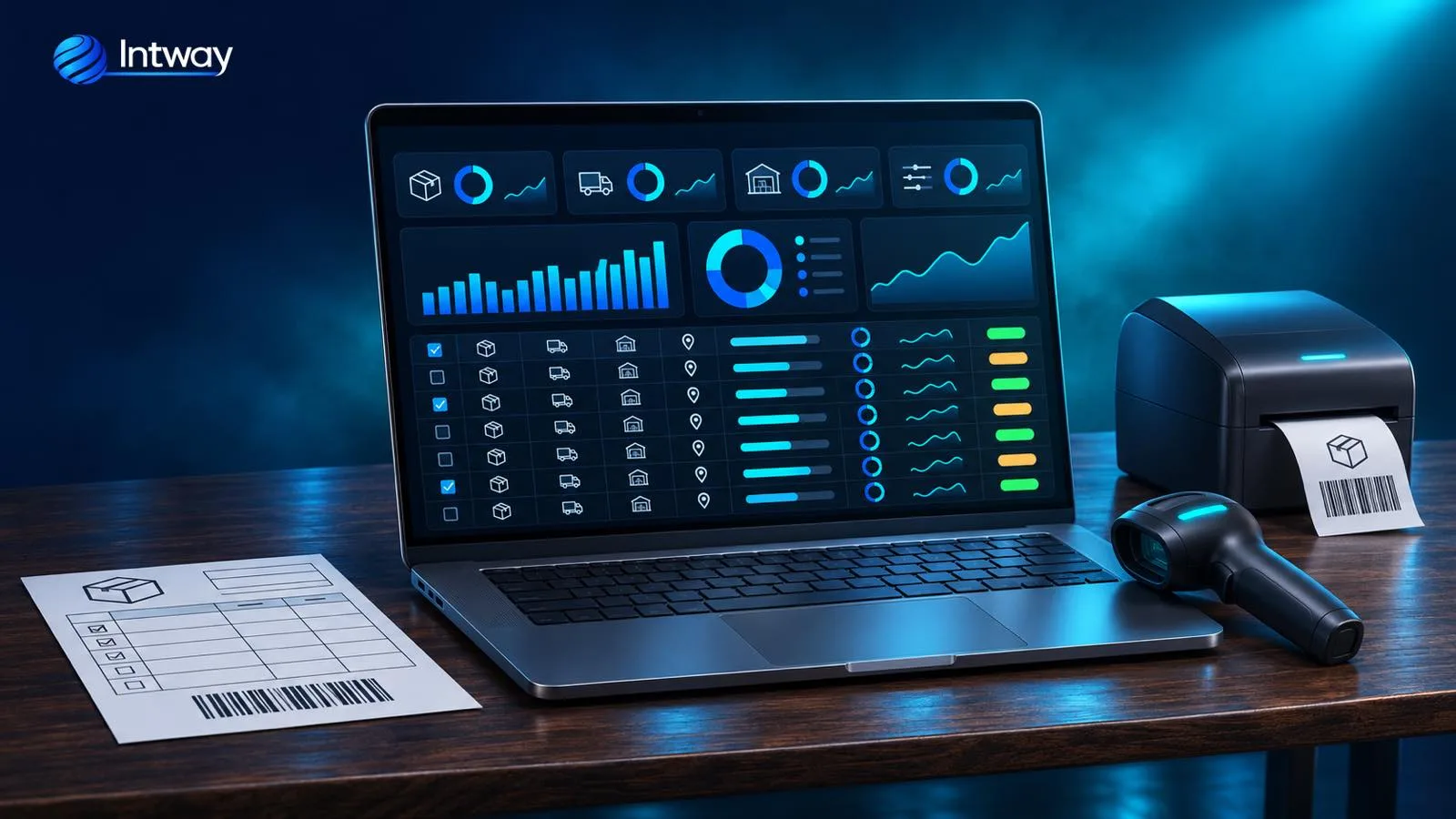
The system that runs your day-to-day operation.
Ver más →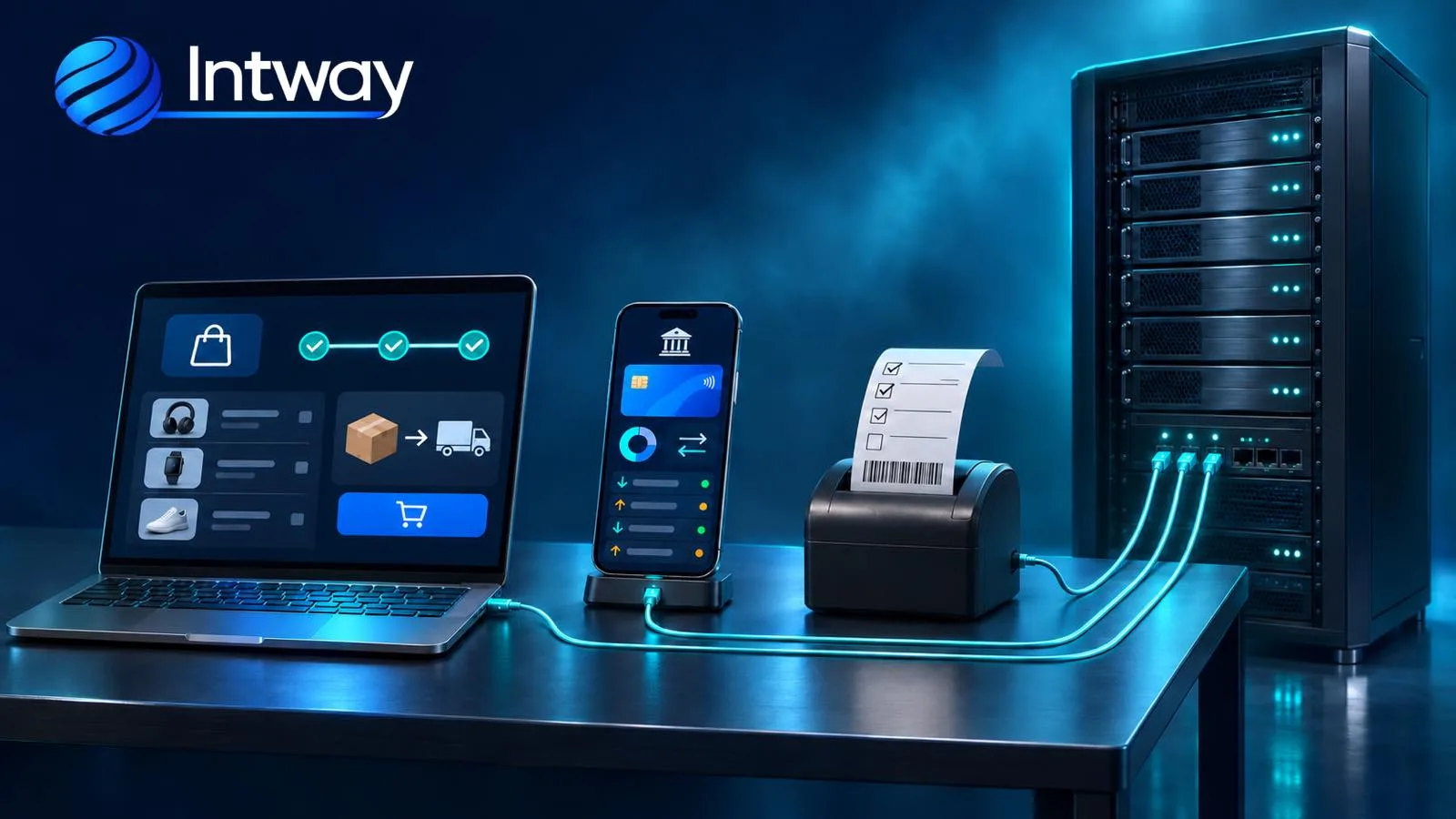
Your systems talk and data is entered once.
Ver más →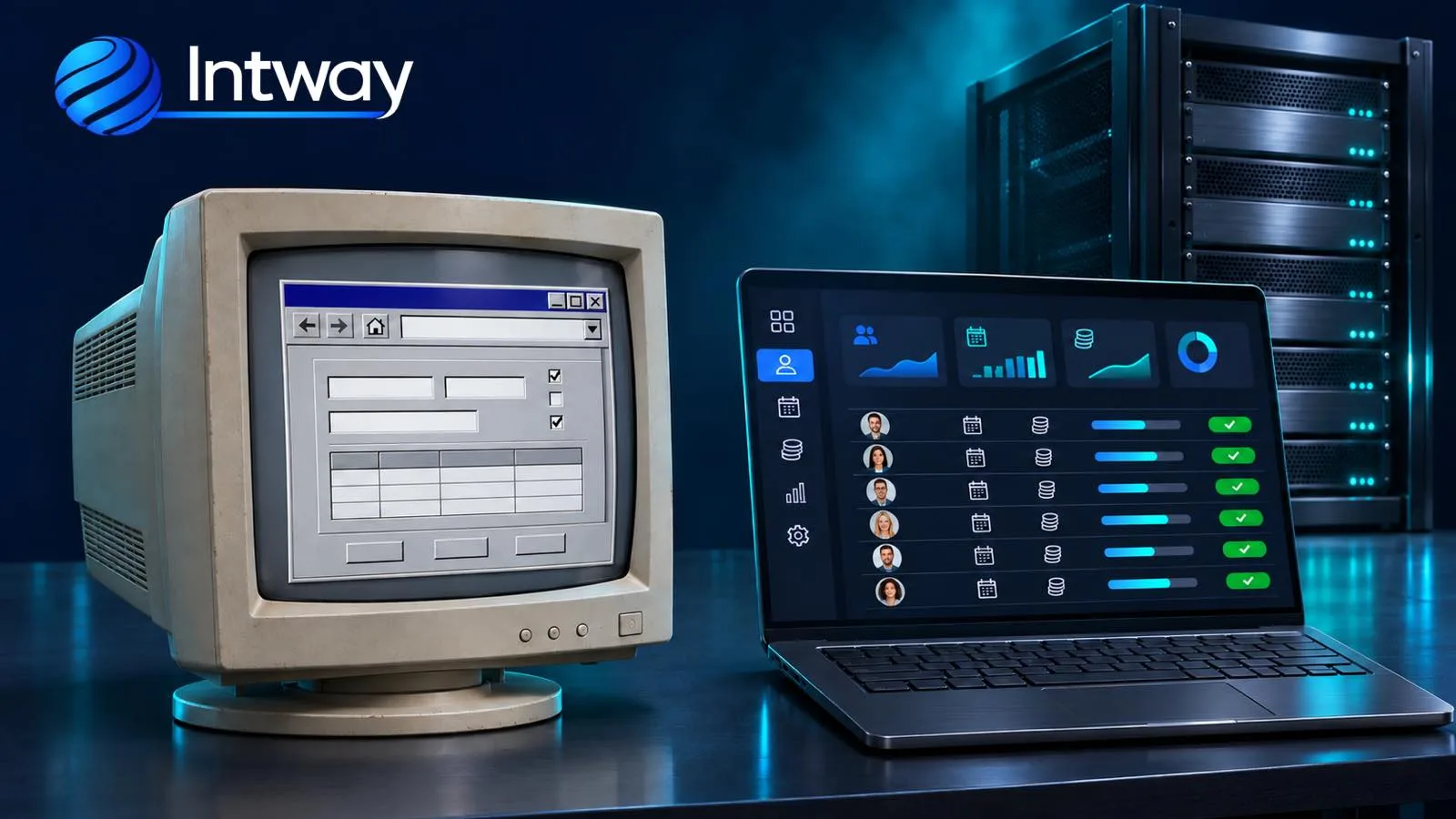
From the old system to the new one, in parts and without stopping.
Ver más →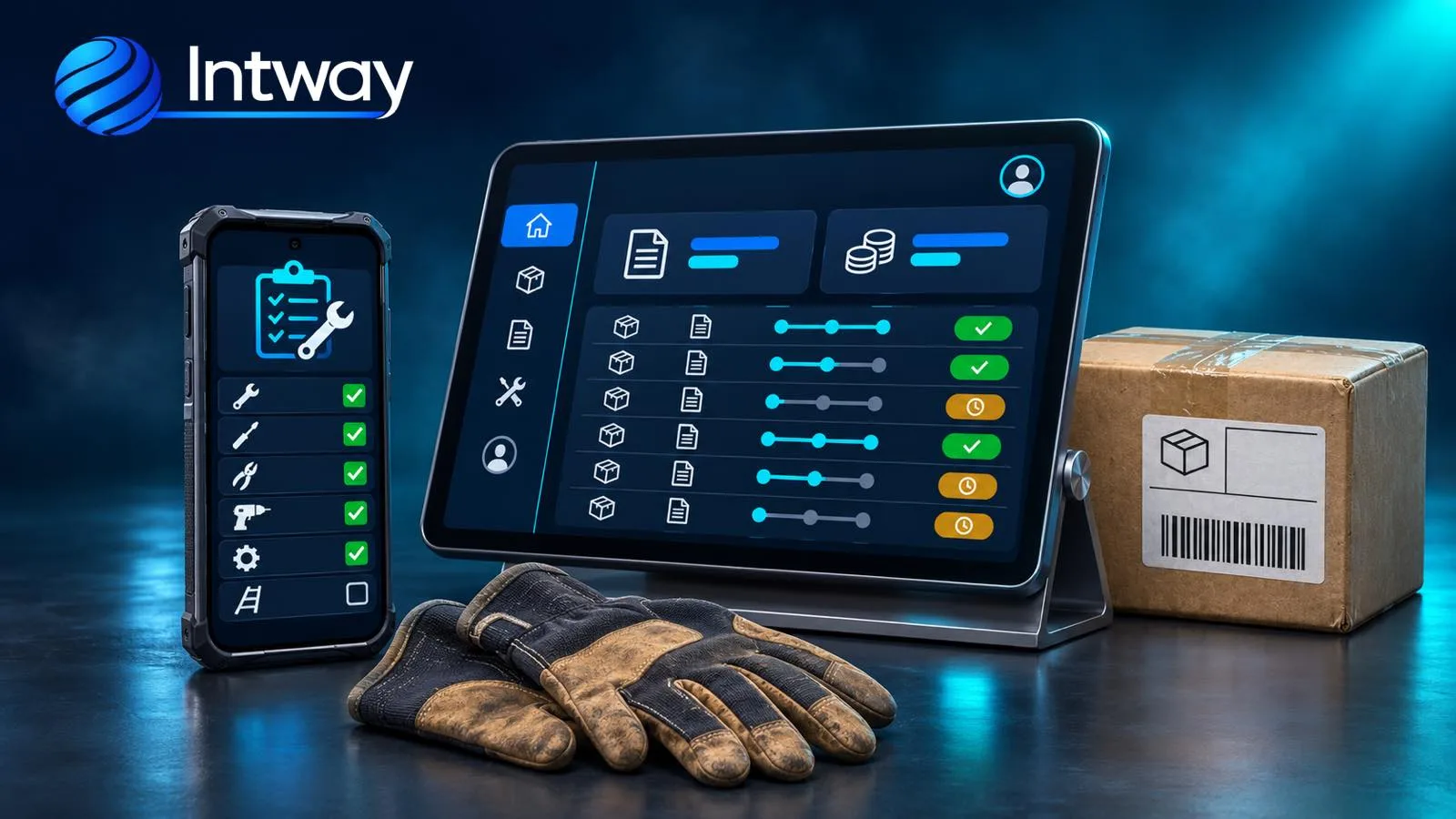
For your field team and for your customers.
Ver más →
AI inside a real process, on your own data.
Ver más →We don't build for its own sake: we build when what you have isn't enough or can't be touched.
The same data is entered in two or three places and nobody knows which one is right.
It works, but every change is a risk and depends on one or two people.
Business rules sit in formulas that get copied, break and leave no trace.
The ERP or SaaS handles the standard part and what sets you apart is left out, done by hand.
We look at how the process works today and what to build first, integrate or leave as it is.
Fixed scope and price for the first stage, in production within weeks.
Releases every two weeks you can see and try, with priorities you can change.
Maintenance, improvements and new stages as your business changes.
Discovery, design, development, testing, go-live and maintenance. Depending on the case, also integration with your systems, data migration and infrastructure in the cloud or on your own servers.
It isn't delivered all at once. The first stage solves a concrete problem and is in production within weeks; the rest is added in stages, with releases every two weeks.
Yes, and it's the most common case. We can integrate it with new systems, add channels without touching it or modernise it in parts, with both systems in parallel until the new one gives the same results.
Yes. The repository, the database and the cloud accounts are in your name, with the documentation another team needs to carry on if you ever need it.
For standard needs, such as accounting or payroll, a product. For what is specific to your business, custom. The most common answer is to combine both and connect them through an API.
After discovery we quote the first stage with a fixed scope and price. The next ones are quoted one at a time, with what was learned in the previous stage.
We'll tell you whether to build, integrate or buy, and how to start with a small first stage.
Contact us