A bank, a financial company or a payment service provider in Argentina, such as a fintech or a digital wallet, can hire an outside firm to build or maintain its software, but it remains accountable for that software to the Central Bank (BCRA). The rule is in the BCRA's consolidated text on minimum requirements for managing and controlling technology and information security risks (in Spanish), which started with Communication "A" 7724 in 2023 and was last updated on February 13, 2026. This guide sums up what it requires when a third party does the development: what must be notified, what the contract must say, how the vendor is monitored, what the software must have and what is handed over at the end. It doesn't replace reading the current text or the institution's legal advice.
Who the BCRA rule applies to
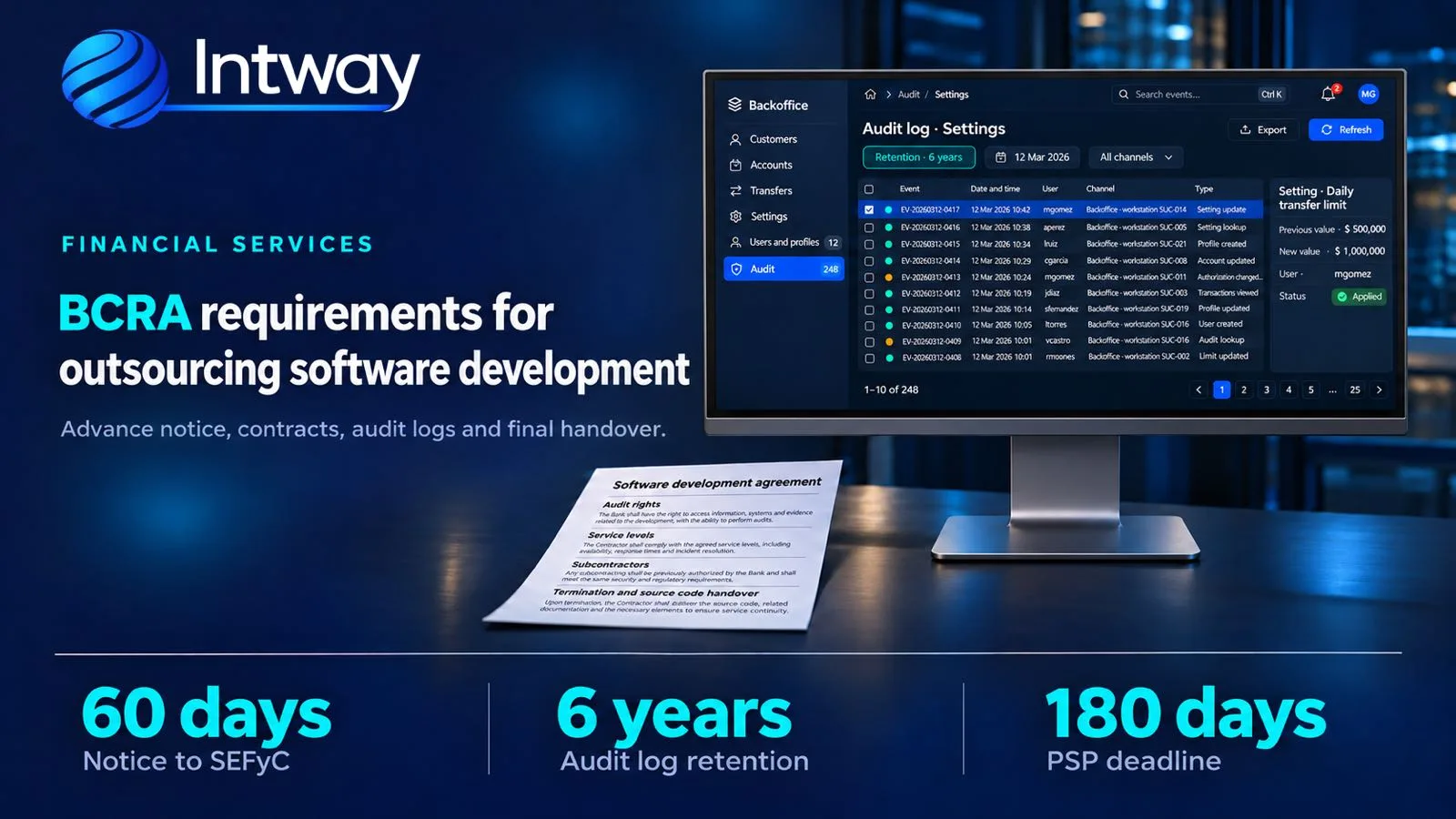
It applies to financial institutions, to the systemically important payment infrastructures (Interbanking, COELSA, LINK and Newpay) and, since Communication "A" 8398 of February 5, 2026, to payment service providers on the BCRA register, such as digital wallets. That communication gave them 180 calendar days to implement it: it applies to them since August 4, 2026.
The rule allows technology to be outsourced in Argentina or abroad, but makes clear the institution is not released from its responsibilities. The risk assessment of each vendor must be documented and approved by the institution's highest local authorities. A vendor abroad must be in a country that applies international anti-money-laundering standards (those of the FATF), and if the SEFyC inspects there, the institution pays the costs. And it can't be outsourced to the firm that performs the institution's internal or external audit.
Before starting: notifying the SEFyC
A financial institution that outsources technology processes or services in a vendor's facilities or infrastructure, using the vendor's technical or human resources, must notify the Superintendency of Financial and Exchange Institutions (SEFyC) at least 60 calendar days in advance: point 2.1 of the BCRA's consolidated text on expansion of financial institutions (in Spanish) says so. Each contract is worth assessing. The technology rule adds what the notice must contain when the service is critical, meaning essential for the institution and the financial system to keep running or to meet legal obligations, and "development, support and maintenance" is among the service types it lists. In that case it goes to the External IT Audit Department, also 60 days ahead, and includes:
- Which services are outsourced, the city and country where they are performed, and where they are controlled from.
- The start date and a contact person at the vendor.
- Every subcontractor, with its task and location.
- The contract and a business continuity plan.
For the vendor this has a practical consequence: if the team later moves or a subcontractor is added, the rule treats it as a new outsourcing, with its own notice.
What the contract must say
The contract must ensure that the outsourced work meets the rule's requirements, including the software ones below, and it has minimum content. For software development, what matters most is:
- Scope, service levels and performance metrics, and the term with its renewal rules.
- Audit rights for the institution and the SEFyC, with access to facilities and documentation of every provider, subcontractors included.
- Confidentiality and coordinated cyber incident management.
- Notice of changes that affect the service, including changes in the vendor's ownership or management.
- A designated representative at the vendor for everything related to the outsourcing.
- How it ends: the termination procedure and the deletion of the institution's data once the relationship is over.
The primary vendor is responsible for everything its subcontractors do, and each subcontractor must formally accept the regulatory framework and the audit rights.
Signing the audit right is not enough: throughout the relationship, the institution must monitor the vendor, assess compliance with the rule and the service levels, follow up on corrective requests when it falls short and run internal audits of the outsourced service. It sets the frequency according to the risk and how critical the service is.
What the software must have
The section on software development, acquisition and maintenance applies the same whether the system is built in-house or by a vendor. These are the requirements that change how it is built:
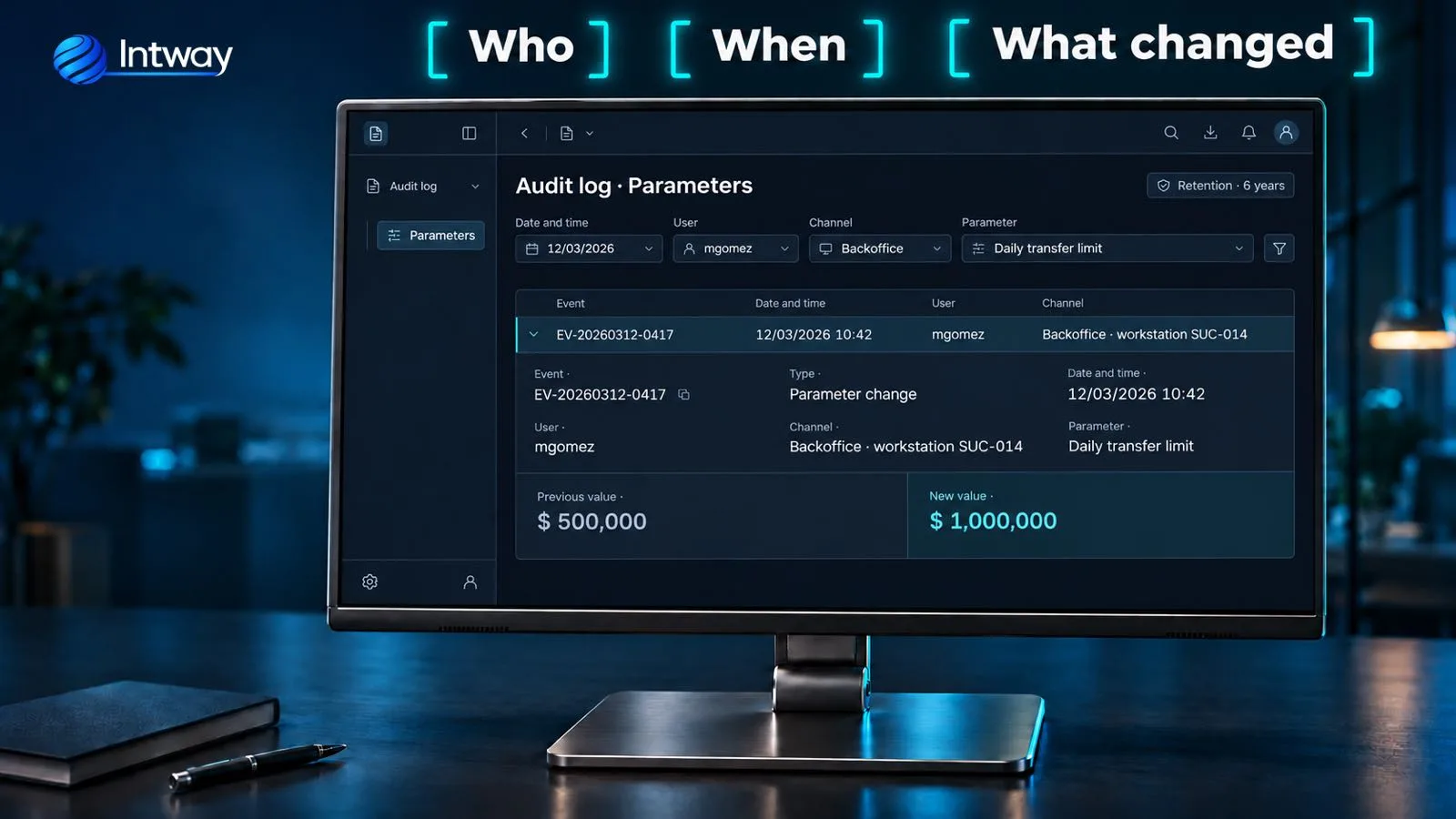
- Audit logs in every system, with a unique identifier, the event type, the date and time, the user, the source device or channel and, when a parameter changes, the previous and the new value. They are kept for at least six years.
- Automated controls over transactions: integrity of what is entered and processed, limits on modifying or deleting completed transactions, movements and balances, consistency between operational and accounting balances, and unique customer identification.
- Users, profiles and permissions managed from the system itself, with authorizations to create, modify or delete transactions and parameters.
- Up-to-date functional, technical and user documentation, and the source code available.
- Secure development: threat modeling, code review and assessment of the third-party components brought in, such as open-source libraries, APIs or artificial intelligence models.
- Vulnerability testing by independent third parties on applications that handle customer, transactional or financial data. Findings are documented and the institution decides how to treat them.
- Quality assurance independent of the development and testing teams.
A fictional example: on March 12, 2026 at 10:42, user mgomez changes the daily transfer limit from $500,000 to $1,000,000 from the back office, at workstation SUC-014. The system stores event EV-20260312-0417 as "Parameter change", with both values.
From change to production
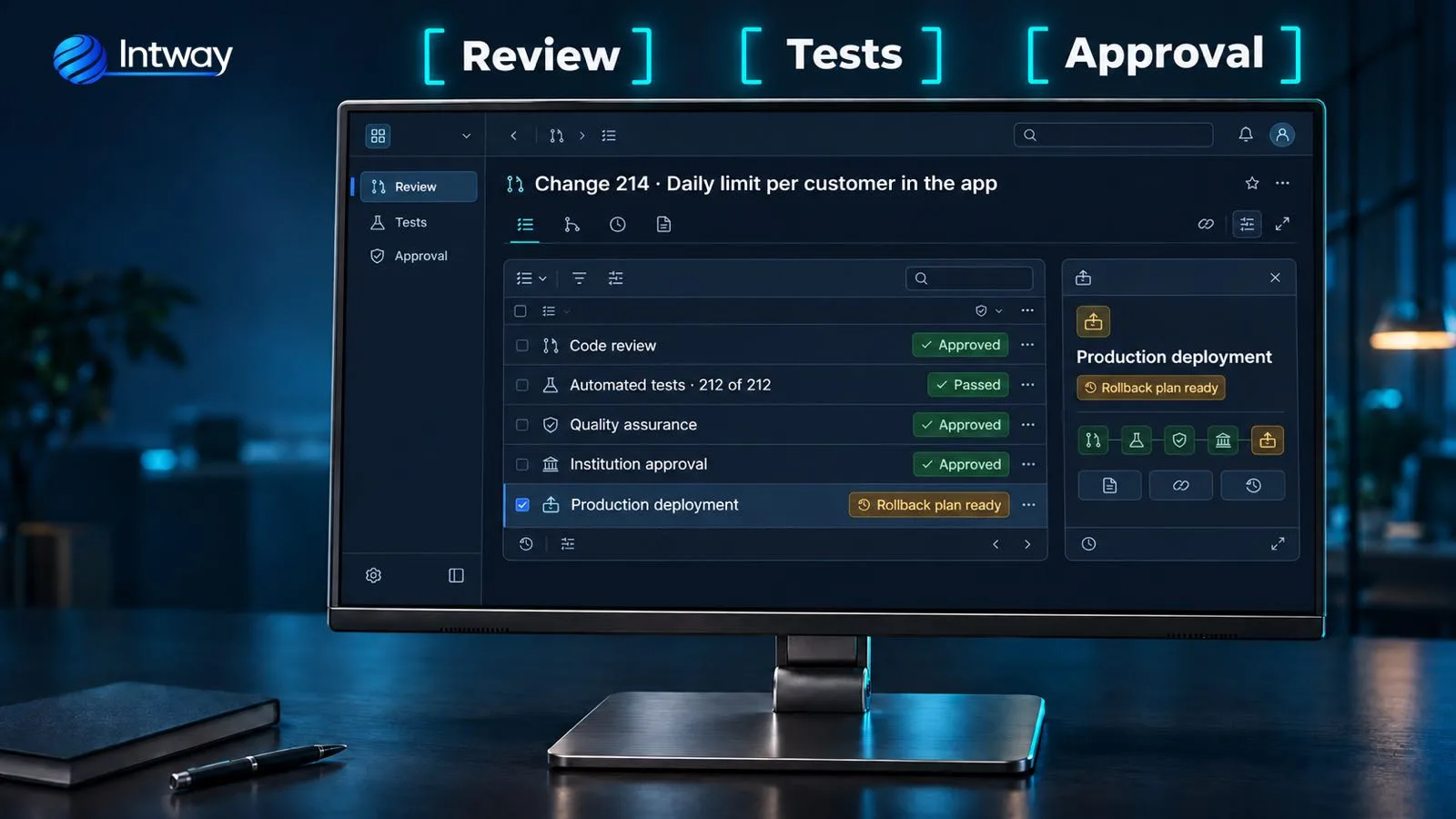
The rule calls for a change management process with segregated duties, separate environments (production apart from all others), approval based on impact, traceability of what moves between environments and the ability to roll back if something fails. When development is outsourced, in practice it works best this way: the vendor codes and tests, and the institution approves the release to production.
Following the example: for the app to enforce a daily limit per customer, change 214 goes through code review, the 212 automated tests, which all pass, and quality approval. It reaches production once the institution approves it, with a rollback plan ready.
When the relationship ends: data, source code and documentation
The institution must have plans for the end of each outsourced service, planned or forced, and those plans must cover how to obtain the data, the source code and the documentation of the systems. In practice, software that only the vendor knows how to build, or whose code lives only on the vendor's servers, puts that plan at risk. Agree from the start where the repository lives and how documentation and data are handed over.
Summary: what the BCRA requires and what the vendor does
| Requirement | Where | What the vendor has to do |
|---|---|---|
| Prior notice to the SEFyC | Point 10.1 and Expansion, section 2 | Provide locations, subcontractors and a contact, and give notice before changing them |
| Minimum contract content | Point 10.3 | Accept audits by the institution and the SEFyC, service levels and termination terms |
| Audit logs kept 6 years | Point 9.1 | Build them into every system, with previous and new values |
| Secure development and testing | Point 9.2 | Threat modeling, code review and documented tests |
| Independent vulnerability testing | Point 9.2.2 | Give an independent third party access and address what it finds |
| Change management | Point 7.2 | Work with separate environments and a rollback plan; the institution approves changes |
| Exit plan | Point 10.2 | Ensure access to data, source code and documentation |
How we work with financial institutions at Intway
We build software for banking and financial services as a software factory. If your institution is about to outsource development, we plan it with these requirements on the table from the start. Our case study on connecting digital channels to a banking core without replacing it shows how each transaction is traced with its own identifier, and how to modernize a legacy system without disrupting operations shows how a system is changed piece by piece.